How Long Does SEO Take to Work? Real Timelines from Our Clients
What You Will Learn
How long does SEO take? For specific, lower-competition searches, expect movement within two to three months. For competitive terms such as “SEO agency Dubai”, expect six to twelve months or more, and real authority builds over 18 to 24 months. The speed depends on where your site starts, how competitive your searches are and how consistently the work is done.
Gateway Marketing Digital has run SEO for businesses in the UAE and abroad since 1997. Instead of a generic answer, here are real timelines from SEO programmes we run, and what made them faster or slower.
How long does SEO take for a new website?
Faster than most people expect for niche searches, slower for broad ones. LKX Translation came to us with a site that had no Google visibility. We rebuilt it on a clean domain with a page for every service, industry and language, then started SEO. Within 11 weeks, its Google impressions grew 3.7x and 52% of the searches it appeared for averaged a top-10 position, including page one for “manufacturing translation services” and “japanese document translation”.
The lesson: specific searches with clear intent move first. Build pages for them from day one, and let the broad terms follow as authority grows.
How long does SEO take for an established business?
Gains compound. For Teko Marine, a global B2B marine supplier, we have run SEO since September 2022. The number of keywords ranking at number one grew from 38 to 176, and 351 of 393 tracked keywords now sit on Google’s first page. In one six-month window the site earned 308,000 organic impressions.
That did not happen in a quarter. In year one, Google Ads and the website brought in 62 B2B enquiries from more than 20 countries while the organic channel was built. As rankings arrived, the strategy shifted weight from paid search to SEO. E-commerce catalogues compound because every product page is another chance to rank.
Does changing your domain or website reset SEO?
Not if the move is planned properly. When Teko Marine moved online to its MaxxMarine brand, we rewrote every category page and redirected every old URL to its exact new equivalent. Weekly Google clicks went from 20 or fewer before the move to between 131 and 185 after it. Sending every old URL to the homepage is the most common mistake, and it throws away years of work.
What makes SEO faster or slower?
Technical foundations: hosting Google can reach, HTTPS, fast mobile pages and clean indexing. No content ranks on a site Google cannot crawl.
Competition: “SEO agency Dubai” has thousands of searches a month and many established competitors. “Japanese document translation” has fewer of both.
One page per search intent: a dedicated page for each service, product or question gives Google a clear page to rank.
Authority: genuine links, listings and mentions from relevant sites take months to build and cannot be rushed safely.
Consistency: monthly content, fixes and monitoring beat a big push followed by silence.
What does a realistic SEO timeline look like?
Month 1: technical audit and fixes, keyword map, Search Console and analytics set up properly.
Months 2 to 3: service and product pages optimised, first new content, niche searches start to appear.
Months 4 to 6: impressions and long-tail rankings climb, first enquiries from organic search.
Months 6 to 12: competitive terms move towards page one as authority builds.
Year 2 onwards: compounding rankings, lower cost per lead than paid search.
Google itself suggests asking any SEO provider what results they expect and in what timeframe, in its guide to whether you need an SEO. A provider who promises page one in 30 days for a competitive term is guessing or cutting corners.
How do you know SEO is working before rankings arrive?
Watch the leading indicators: more pages indexed, more search queries showing your site, rising impressions and average positions improving on specific terms. On our own website, our generative engine optimisation page moved from an average position near 19 to the top five for “generative engine optimization services in Dubai” in about a month, well before it brought enquiries. Our post on what services to expect from an SEO company in Dubai covers what a monthly report should include.
If you need leads while SEO builds, run Google Ads alongside it, as we did for Teko Marine, then shift budget as organic rankings arrive. Our SEO agency in Dubai page explains how we plan that mix.
FAQ: how long does SEO take
Can SEO work in one month?
You can see early signals in a month, such as more impressions and better positions on niche terms, especially after technical fixes. Business results like steady enquiries usually take three to six months.
Why is my website not showing on Google after months?
The usual causes are pages Google cannot crawl or has not indexed, no HTTPS, thin content, or targeting only broad, competitive terms. Check Search Console’s indexing report first.
Is SEO faster in Dubai than in bigger markets?
Some Dubai niches have less competition than the same terms in the US or UK, so they can move faster. Core agency, property and finance terms in Dubai are highly competitive and take longer.
Should I stop SEO once I rank?
No. Competitors keep publishing and earning links, and Google keeps updating. Rankings that are not maintained slip, often slowly enough that nobody notices until enquiries drop.
Next step
How long does SEO take for your site depends on its starting point and your market. If you want a realistic timeline for your own business, contact our team and we will review your current visibility first.
Lead generation cost in Dubai is set by four things: the channel, the offer, how hard the form qualifies people, and how fast your team follows up. The same budget can produce leads at AED 53 or at AED 280 depending on those four choices. What matters is not the cheapest lead but the cost of a lead that turns into a viewing, a booking or a sale.
Gateway Marketing Digital has run lead generation for UAE businesses since 1997. Below we break down what pushes the cost per lead up or down in Dubai, with real figures from campaigns we have published as case studies, and how to judge whether a quote you have been given makes sense.
What decides lead generation cost in Dubai?
There are two costs to look at. The first is media cost: what Meta or Google charges you to reach people and get them to raise their hand. The second is the cost of the system around the ads: landing pages, creative, tracking, the lead sheet or CRM, and the people who call leads back. A low media cost with a weak system still produces expensive customers, because most of the leads go nowhere.
So the useful number is cost per qualified lead, and after that cost per sale. Any lead generation cost in Dubai should be read next to those two figures.
1. Which channel brings the lead in?
Meta ads (Facebook and Instagram) create demand: you reach people before they search, so leads are usually cheaper but colder. Google Search captures people already looking, so clicks cost more but intent is higher. WhatsApp sits on top of both, and in the UAE it often decides quality.
On the Dubai Jewel Tower launch for Rocky Real Estate, 44% of WhatsApp leads qualified, against 11% of Meta lead form leads. The form leads were cheaper to buy. The WhatsApp leads were far cheaper per qualified buyer.
2. How valuable and how clear is the offer?
A specific offer with one clear next step costs less per lead than a general brand message. A free masterclass, a property brochure or a consultation gives people a reason to act now. For coaching brand Anita Milovac, a masterclass funnel we built brought in 372 leads at AED 6.58 each, about a third below the target set before launch, because the offer itself was the first taste of the coaching.
High-value purchases cost more per lead, and that is fine. A Dubai property buyer or a three-month meal plan subscriber is worth thousands of dirhams, so the business can afford to pay more for each serious enquiry.
3. How much does the form qualify people?
Every question you add to a form raises the cost per lead and lowers the number of leads. It also removes time wasters. For Simply Healthy Diets, the landing page form asked for the plan wanted, days per week and the main goal before contact details. The campaign produced 164 qualified enquiries in five months, and at least 6.7% became clients worth AED 7,000 to 8,000 each.
The rule we use: qualify harder when your sales team is small or your product is expensive, and qualify lightly when volume matters and follow-up is automated.
4. What is the campaign told to optimise for?
Meta and Google find more of whatever you tell them counts as a result. If that is a form fill, they find form fillers. If your real outcomes (qualified, viewed, booked, paid) are sent back to the platforms, they learn to find buyers. Google calls this offline conversion import, and Meta has the Conversions API for the same job.
When the Dubai Jewel Tower campaigns were judged on qualified rate instead of raw volume, cost per lead fell 41% within a month, from AED 176 to AED 103, while the qualified rate rose from 22.4% to 31.8%. In the second phase the campaigns delivered about 944 leads at about AED 53 each, around 81% below the approved target of AED 280.
5. How fast does someone call the lead back?
Follow-up speed does not change the price you pay Meta for a lead. It changes how many of those leads you keep. A lead called within the first hour is far more likely to book than one called the next day, so slow follow-up quietly doubles your real cost per sale. Instant alerts to the sales team and a lead sheet that tracks every contact attempt are part of the cost, not an extra.
6. How competitive is your market in the UAE?
Dubai real estate, finance and premium services compete with many advertisers for the same audiences, especially in peak seasons, so media costs rise. Niche B2B offers often have fewer competitors in the auction but smaller audiences. Seasonality matters too: Ramadan, summer and year-end all shift costs in the UAE, which is why campaigns are planned a quarter ahead.
How do lead generation companies charge?
You will see three models in Dubai. Each one moves the risk to a different side of the table.
Monthly management fee plus ad spend: you own the ad accounts and pay the platforms directly. Most transparent, and you keep all the data.
Pay per lead: predictable on paper, but the provider is rewarded for volume, so define a qualified lead in writing first.
Performance or commission: the provider is paid on sales. Fair when sales tracking is reliable, risky when it is not.
Whichever model you pick, ask who owns the leads, the ad accounts and the pixel. We cover that in more detail on our lead generation agency in Dubai page.
How to judge a lead generation cost in Dubai before you spend
Work out what a customer is worth to you over the first year.
Estimate your close rate from a qualified lead (your sales history is the best guide).
Divide the acquisition cost you can afford by the leads needed per sale. That is your ceiling cost per qualified lead.
Compare any quote or target against that ceiling, not against what another business pays.
For high-value buyers, the maths usually allows a higher cost per lead than people expect. Our post on high-ticket lead generation in the UAE walks through that side.
FAQ: lead generation cost in Dubai
What is a good cost per lead in Dubai?
It depends on what a customer is worth. Across our published campaigns, cost per lead ranged from AED 6.58 for a coaching masterclass to about AED 53 to AED 149 for Dubai property. Judge it against your qualified rate and close rate, not against another industry.
Are cheap leads a bad sign?
Not always, but check them. Cheap lead form leads often qualify at a lower rate: on one Dubai property launch, 11% of form leads qualified against 44% of WhatsApp leads. Look at the cost per qualified lead before you celebrate a low cost per lead.
How long before the cost per lead settles?
Expect the first two to four weeks to be the most expensive while the platforms learn. On the Dubai Jewel Tower launch, cost per lead fell 41% within the first month once budget moved to the channels producing qualified buyers.
Should I pay per lead or pay a monthly fee?
A monthly fee with ad accounts in your name keeps the data and the learning with you. Pay per lead can work for simple offers, but only with a written definition of a qualified lead and the right to reject leads that do not meet it.
Next step
The right lead generation cost in Dubai is the one your sales maths can carry, measured on qualified leads and sales. If you want us to look at your current cost per lead and where it leaks, contact our team.
For businesses selling premium products and services, generating more leads does not automatically mean generating more revenue. A luxury real estate developer, yacht charter company, wealth management firm, or premium car rental business may have little to gain from hundreds of enquiries if most prospects have no genuine purchasing intent.
This makes luxury lead generation in UAE strategies fundamentally different from campaigns built around volume. The objective is not simply to reduce cost per click or collect as many form submissions as possible. It is to identify prospects whose needs, purchasing capacity, timing, and intent align with a high-value offer.
The UAE is particularly relevant to this approach. Dubai continues to attract substantial international wealth, with Knight Frank reporting 500 residential sales above US$10 million in 2025, worth US$9.05 billion in total.
For high-ticket businesses, the real marketing challenge is not getting more attention. It is turning the right attention into qualified conversations.
Why HNWI Lead Generation Requires a Different Strategy
Marketing to high-net-worth individuals requires more than placing an advertisement in front of people who appear affluent. The buying journey for a premium product can involve research, comparison, trust-building, and personal consideration.
Someone considering a luxury property may evaluate the developer, location, amenities, investment potential, reputation, and resale prospects before making an enquiry. A wealth management prospect may similarly assess credentials, expertise, privacy, and the quality of the client’s experience.
That also changes how campaigns should be measured. A campaign generating 500 low-quality enquiries may be considerably less valuable than one producing 50 qualified prospects.
Understanding the UAE’s HNWI Digital Journey
The UAE’s luxury market is not built around a single type of buyer. International investors, regional HNWIs, expatriates, entrepreneurs, and established residents can have very different motivations for purchasing premium products and services.
Knight Frank’s 2025 research illustrates this diversity. Its survey of 387 HNWIs across India, Saudi Arabia, the UK, and East Asia found that 33% intended to invest in UAE real estate during 2025, while Dubai was the preferred emirate among 68% of respondents interested in a real estate purchase.
A Saudi investor, an Indian entrepreneur, and an international buyer may all be interested in Dubai but have different priorities, timelines, and questions.
Consider an international investor researching Dubai property. They might discover a development through Google, visit the developer’s website, compare locations, watch property videos, read reviews, investigate the developer, and return several times before contacting a sales team.
A strong HNWI marketing Dubai strategy needs to support this journey rather than expecting a single advertisement to produce an immediate conversion.
This is especially relevant in the UAE, where many high-value purchases involve international or cross-border decision-making. A prospect may not be physically present in Dubai when they first discover a property, yacht, investment service, or luxury experience. Digital marketing therefore needs to build enough credibility for the prospect to continue researching before speaking with sales.
How to Target HNWIs Through Paid Search and PPC
Paid search is valuable for high-ticket businesses because it can capture prospects already expressing a specific need.
However, marketers should not assume advertising platforms can simply identify someone as an HNWI. Campaigns should instead use search intent, relevant audience signals, location, behavior, and qualifications to improve the likelihood of reaching valuable prospects.
Consider the difference between:
“Dubai apartments”
and:
“Dubai luxury penthouse for sale”
The first query is broad and could represent early-stage research. The second communicates a more specific requirement and potentially stronger commercial intent.
For a luxury real estate company, this difference can influence campaign structure, ad copy, landing pages, and bidding strategy.
Campaigns could separate searches around:
Luxury apartments in Dubai
Waterfront villas
Branded residences
Investment properties
Specific premium communities
High-value property types
This is where real estate PPC Dubai campaigns can become more efficient. Rather than sending every searcher to the same generic page, advertisers can align keywords, advertisements, and landing pages with the prospect’s specific interest.
Negative keywords are equally important. They can prevent spend on searches unrelated to the commercial offer, such as free listings, low-budget rentals, jobs, or unrelated property information.
Broad targeting can be wasteful when the product or service has a high price point.
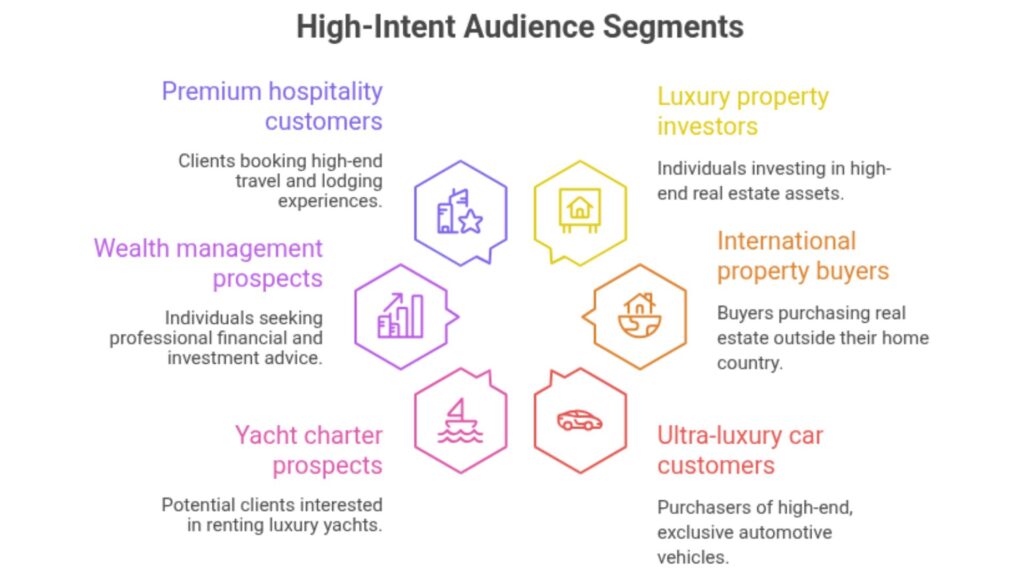
Businesses should build campaigns around specific customer profiles and commercial needs, such as:
Luxury property investors
International property buyers
Ultra-luxury car customers
Yacht charter prospects
Wealth management prospects
Premium hospitality customers
Segmentation should go beyond demographics. A luxury property business could distinguish between an investor seeking rental returns and an end-user looking for a primary residence or second home. A yacht charter company could segment prospects by destination, group size, charter duration, and type of experience.
For UAE businesses, this could also mean separating local, GCC, and international audiences. International property campaigns may need to focus more heavily on remote buying support, location information, investment considerations, and trust.
Website behavior provides additional context. Someone who has visited several product pages, downloaded information, watched a video, and returned to the website may represent a different opportunity from someone who clicked a general awareness advertisement once.
The goal is not to create the biggest possible audience. It is to create an audience where relevance and intent justify the advertising investment.
Your Landing Page Should Qualify Leads, Not Just Collect Them
Generating the click is only the beginning.
A high-ticket campaign can attract the right audience and still produce poor results if the landing page fails to establish trust or qualify enquiries.
Premium landing pages should consider:
Clear and credible value propositions
High-quality visual presentation
Trust signals and social proof
Relevant credentials
Testimonials where appropriate
Privacy assurances
Strong but non-aggressive calls to action
Useful qualification questions
Instead of a generic “Submit Your Details”, a luxury property business might use “Request a Private Consultation” or “Speak with a Property Specialist”.
A property developer could also ask about preferred location, property type, intended use, approximate investment range, and purchasing timeframe. These questions should help the sales team understand whether an enquiry represents a genuine opportunity.
This is where conversion rate optimization becomes more than increasing form submissions. For high-ticket businesses, CRO should also focus on improving the quality and relevance of the leads generated.
Why Lead Quality Matters More Than Cost Per Lead
Cost per lead is useful, but it should not become the only measure of campaign success.
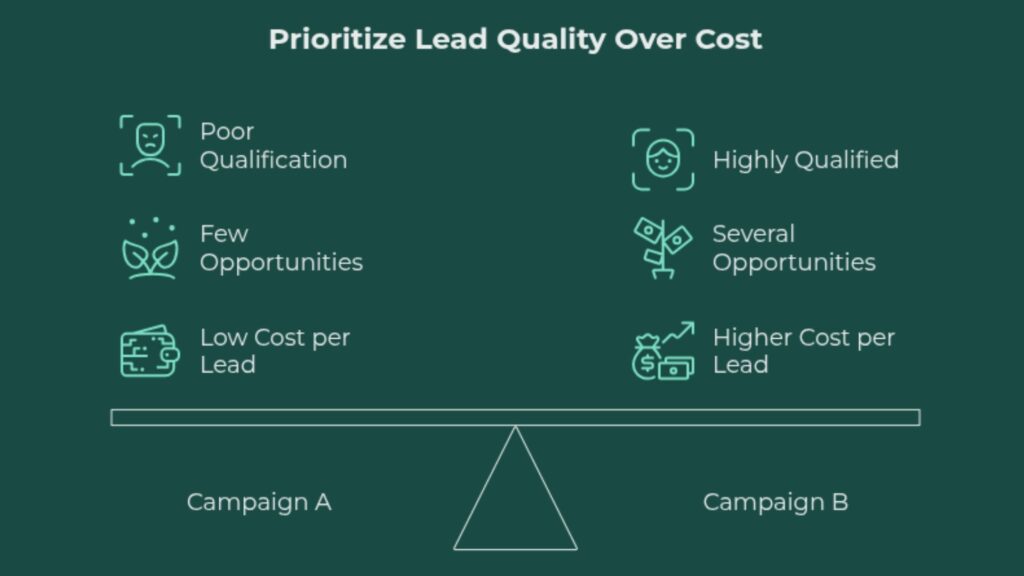
Consider two hypothetical campaigns.
Campaign A
500 leads
Low cost per lead
Poor qualification
Few genuine sales opportunities
Campaign B
50 leads
Higher cost per lead
Highly qualified prospects
Several genuine sales opportunities
Campaign A looks better if the only metric is lead volume. But Campaign B could be significantly more valuable if those 50 prospects generate more opportunities and revenue.
High-ticket businesses should therefore monitor metrics beyond CPL, including:
Cost per qualified lead
Lead-to-opportunity rate
Opportunity-to-sale rate
Customer acquisition cost
Revenue per lead
Return on ad spend
Sales feedback can also inform future targeting and optimization.
A $200 qualified lead is not necessarily expensive if it contributes to a substantial sale. Likewise, a $10 lead is not necessarily cheap if it consumes sales resources without producing a meaningful opportunity.
The real question is not “How much did the lead cost?” but “What was the lead worth?”
Retargeting: Staying Visible Throughout the Buying Journey
High-ticket prospects often need time before making a decision. They may be comparing properties, discussing an investment with family or advisors, researching competitors, or waiting for the right opportunity.
Retargeting can help businesses remain visible during this process.
Useful audiences may include:
Website visitors
Property or product page visitors
Video viewers
Previous ad engagers
Visitors who started but abandoned an enquiry
The messaging should reflect the prospect’s previous interaction. Someone who viewed a specific property could receive relevant content about that development rather than another generic brand advertisement.
For international audiences, retargeting can reinforce useful information such as location guides, property walkthroughs, investment-focused content, testimonials, or buying-process information.
Effective retargeting should feel like a continuation of the customer’s journey, not an attempt to force a decision.
The Role of AI in High-Ticket Lead Generation
AI can strengthen high-ticket marketing when it is used to improve decision-making rather than treated as a shortcut to finding wealthy customers.
AI can help marketers analyze campaigns, CRM, and website behavior to identify patterns associated with stronger engagement. Marketers can look at signals such as pages viewed, repeat visits, content engagement, enquiry behavior, and previous interactions.
For example, imagine a Dubai property campaign where one prospect visits a generic property page once, while another views several luxury developments, returns multiple times, watches a project video, downloads a brochure, and eventually starts an enquiry.
AI-assisted analysis can help identify these behavioral patterns and prioritize prospects showing stronger signals of intent. Marketing teams can then use those insights to refine audience segments, landing pages, ad messaging, and budget allocation.
AI can also support audience analysis, ad personalization, predictive lead scoring, campaign optimization, customer segmentation, and high-intent behavior analysis.
However, AI cannot replace qualification or human judgment. A model may identify a pattern associated with strong engagement, but a sales professional still needs to determine whether the prospect’s budget, needs, timing, and expectations genuinely align with the offer.
Used properly, AI helps marketing and sales decide where to focus attention and budget.
Stop Chasing Clicks, Start Chasing Intent
High-ticket lead generation in the UAE requires precision rather than volume. For businesses targeting affluent customers, effective marketing means understanding who the ideal prospect is, what signals indicate genuine intent, and what information they need before starting a conversation.
PPC can capture high-intent demand, audience segmentation can improve relevance, landing pages can qualify enquiries, retargeting can support longer buying journeys, and AI can help identify patterns that improve campaign decisions. Most importantly, businesses need to measure what happens after the lead, from qualification and opportunity to sale and revenue.
For UAE businesses looking to build a more targeted, performance-focused acquisition strategy, Gateway Marketing Digitalbrings together high-intent PPC, SEO, performance marketing, conversion optimization, and lead generation to help businesses attract relevant prospects and turn them into genuine sales opportunities.
For high-ticket businesses in the UAE, the objective isn’t to win the most clicks. It’s to win the right customers.
If you are deciding how to choose a lead generation company in Dubai, judge every option on one question: can they show you which leads became booked meetings and paid sales, not just how many forms were filled? A company that tracks leads through to revenue will grow your sales. One that only reports cost per lead will grow its own report.
Gateway Marketing Digital has been a Dubai marketing agency since 1997, and today we run lead generation on Meta, Google, SEO and WhatsApp for businesses across the UAE. Below are the seven checks we would use if we were hiring an agency ourselves, the red flags to walk away from, and the questions to ask on the first call.
How to choose a lead generation company: what matters most?
Four things decide whether a lead generation company makes you money: how they define a lead, how they track it after the form, who owns the data, and how fast each lead reaches your sales team. Channel lists, pricing models and creative styles all matter, but they come after these four. If an agency cannot answer them clearly on the first call, the rest of the proposal does not matter.
1. Do they agree what a qualified lead is before launch?
A lead is not a name and a phone number. For a property developer it may be a buyer with a budget above a set level and a timeline under six months (our guide to real estate lead generation in Dubai goes deeper on property). For a B2B service it may be a company of a certain size with a named decision maker. Ask the agency to write down, with you, what counts as a qualified lead and what does not.
That definition should then shape everything: the questions on the form, the wording of the ad and the audience. Ads that state the location, the offer and who it is for filter out the wrong people before they ever click.
2. Can they track every lead through to a sale?
This is the check most agencies fail. Ad platforms count a form submission as a conversion, so a campaign can look excellent in Ads Manager while your sales team says the leads are poor. The fix is closed loop tracking: the result of each lead is recorded and sent back to the ad platform, so it learns to find more people who actually buy.
Here is how we run it for our clients. Every lead lands in a lead sheet that belongs to that client only, with the campaign, ad and source attached. The client’s team marks each lead’s status (contacted, booked, showed, paid) and the sale value. We send those outcomes back to Meta through the Conversions API and to Google Ads through offline conversion imports, and our daily review of every client account reads those real outcomes, not just the platform’s own lead count. Internal test bookings are removed before anything reaches Meta, so they never teach the algorithm the wrong thing.
Ask any agency you speak to: “Show me a report where you can see which ads produced paying customers.” If they can only show clicks and cost per lead, the tracking stops at the form.
3. Who owns the leads, the ad accounts and the data?
Your ad accounts, your pixel and your lead data should sit in your own business accounts, with the agency given access. If the agency runs your ads from its own account, you lose the history, the audiences and the learning the day you leave. Ask directly: “If we stop working together, what do we keep?” The right answer is everything.
4. How do they track WhatsApp leads in the UAE?
In Dubai many buyers would rather send a WhatsApp message than fill in a form. Click to WhatsApp ads are a natural way to start that conversation, but many agencies cannot tell you which ad produced which chat, so those leads disappear from the report.
Ask how each WhatsApp enquiry is logged and matched to the ad that produced it. In our setup, every chat that starts from a click to WhatsApp ad is logged as its own row in the client’s lead sheet, so it is counted and followed up next to form leads instead of living only in someone’s phone.
5. How fast does a new lead reach your sales team?
A lead that waits overnight goes cold, especially when the same person has enquired with three competitors. Ask how leads are delivered (email alert, CRM, WhatsApp notification), who receives them, and what happens if a delivery fails. Our lead systems record every push to the lead sheet or alert email and retry it automatically when a service fails, so a lead is never lost silently. Ask for the same promise from anyone you hire.
6. Can they show real proof with dates and numbers?
Ask for a public case study with real numbers, the time period and the channels used. Vague claims such as “3x results” with no dates are a warning sign. For example, our Slim Polyclinic case study shows 576 leads and 108 completed treatments in the first 90 days, with the channels and dates listed on the page. That is the level of detail to expect.
Also ask whether the agency has worked with businesses that sell at your price point. Generating leads for a premium service is a different job from generating leads for a low cost product. Our guide to high ticket lead generation in the UAE explains why.
7. Which pricing model fits your business?
Lead generation companies in Dubai usually charge in one of three ways, and each one changes what the agency is rewarded for:
Monthly retainer, ad spend paid separately: the most transparent model. You pay the platform directly from your own ad account and pay the agency for management.
Pay per lead: simple to budget, but the agency is paid for volume, so quality often slips unless the lead definition is strict and written down.
Hybrid: a base fee plus a bonus tied to qualified leads or sales. This aligns both sides, but only works when outcomes are tracked as described in check 2.
Whichever model you choose, the price of each lead depends far more on your offer, your audience and how fast your team follows up than on the agency’s fee. Our guide to lead generation cost in Dubai breaks down what actually drives it.
What are the red flags when choosing a lead generation company in Dubai?
A guaranteed number of leads before they have seen your offer, your website or your sales process.
Ad accounts or lead data held in the agency’s name instead of yours.
Reports that show only impressions, clicks and cost per lead, with no link to booked meetings or sales.
No questions about who follows up leads or how fast.
Lead lists that are bought, shared or “exclusive” with no explanation of where the contacts came from.
What should you ask on the first call?
How will we define a qualified lead together?
How will the result of each lead get back to Meta and Google?
Whose name are the ad accounts, pixel and lead data in?
How are WhatsApp enquiries tracked and matched to ads?
What happens if a lead fails to reach our team?
Can we see a case study with dates, channels and numbers?
FAQ: how to choose a lead generation company
What does a lead generation company in Dubai actually do?
A lead generation company plans and runs the campaigns that bring enquiries to your business, usually through Meta (Facebook and Instagram) ads, Google Ads, SEO, landing pages and WhatsApp. A good one also sets up the tracking that shows which of those enquiries became booked meetings and paid sales, so budget moves towards the campaigns that sell.
Is pay per lead better than a monthly retainer?
Not by default. Pay per lead looks safer, but it rewards the agency for volume, so lead quality often drops. A monthly retainer with the ad spend paid from your own ad account is more transparent, because you see every dirham spent and every lead it produced. A hybrid model with a bonus tied to qualified leads or sales can work when both sides agree the definition in writing.
How long before a lead generation campaign shows results?
Paid campaigns on Meta and Google usually bring the first enquiries soon after launch. Judging lead quality takes longer: wait until enough leads have moved through your full sales cycle to see how many booked, showed up and bought. SEO is slower and builds over months, which is why most businesses run paid and organic together.
Should the agency or my own team follow up the leads?
In most cases your own sales team should speak to the lead, because they know the product and close the sale. The agency should make sure every lead reaches your team instantly, with the campaign it came from, and should read your follow-up outcomes to improve targeting. If nobody records what happened after the call, no agency can tell you which campaigns are working.
Next step
Knowing how to choose a lead generation company comes down to evidence: clear lead definitions, tracking to the sale, data you own and leads that reach your team fast. If you want to see how we set this up, read about our lead generation agency in Dubai services, or contact our team to talk through your current campaigns.