Opens in a new tab

How to Choose an AI SEO Agency: 7 Checks Before You Sign

What You Will Learn

If you are working out how to choose an AI SEO agency, ask them to show you, question by question, whether ChatGPT, Perplexity, Gemini and Google AI Overviews mention your business today, and who they cite instead. An agency that cannot measure AI answers cannot improve them. The good ones start with that baseline, then fix access, content and third-party citations, and report the change every month.

Gateway Marketing Digital runs AI SEO, generative engine optimisation (GEO) and answer engine optimisation (AEO) for UAE businesses, alongside classic SEO. Here are the seven checks we would use to choose an AI SEO agency, and the claims that should make you walk away.

What does an AI SEO agency actually do?

AI SEO is the work of getting your business named and cited when people ask AI tools for a recommendation, such as “which agency in Dubai is best for Meta ads” or “best translation company for Japanese documents”. AI assistants build those answers from pages they can read and sources they trust: your own site, directories, review sites, list articles and forums. So the job covers your website and your presence across the web.

It is not a separate trick. Google says plainly in its guide to AI features and your website that there are no extra requirements or special optimisations to appear in AI Overviews or AI Mode: the same SEO fundamentals apply. Any agency that sells AI SEO as something unrelated to good SEO is selling you a story.

1. Do they measure your AI visibility before they start?

Ask for a baseline: a list of the questions your buyers ask, run through ChatGPT, Perplexity, Gemini and Google AI Overviews, showing whether you are mentioned, whether your site is cited, and which sources are cited instead. We run this monthly on our own site and for clients, with buyer questions first (“best”, “which agency”, “near me”, “price in Dubai”) and informational questions second. Without a baseline there is nothing to report against.

2. Will they check that AI crawlers can read your site?

Many sites block AI crawlers without knowing it, often through a firewall or a Cloudflare bot setting. If GPTBot or PerplexityBot gets a 403 error, those tools cannot read or cite your pages, whatever your content says. A serious agency checks crawler access in your security settings in week one. Ask how they verify it; testing with a faked bot name from a laptop gives false results.

3. Do they write content that answers buyer questions directly?

AI answers lift short, specific, well-structured passages. Pages should give the direct answer in the first two or three sentences, use question-style headings, include an FAQ with FAQ schema, and carry real numbers with named sources. Ask to see a page the agency wrote and point to the sentence an AI tool would quote.

4. How will they win citations outside your website?

For buyer questions, AI tools lean heavily on third-party sources. When we checked the question “what are the best digital marketing agencies in Dubai”, the answers cited agency directories such as Sortlist, Semrush Agency Partners, Clutch and DesignRush, plus “top agencies in Dubai” list articles. An AI SEO agency should name the exact sources cited for your questions and have a plan to get you onto them: complete profiles, genuine reviews and inclusion requests.

5. Will they keep your business facts identical everywhere?

AI tools match your business across sources by its name, address, phone, founding year and services. If your website says one thing, your Google Business Profile another and a directory a third, the tools are less sure the mentions are the same business. Ask how the agency audits and fixes these facts, and whether they add Organization or LocalBusiness schema with your official profiles listed.

6. Can they show real results, with names?

Ask for case studies with the client named. For Teko Marine, our SEO and AEO work put 351 of 393 tracked keywords on Google’s first page and 176 at number one, with growing visibility in Google’s AI Overviews. For LKX Translation, we added structured data so search engines and AI tools understand exactly who the company is, and its Google impressions grew 3.7x in 11 weeks. On our own site, our generative engine optimisation page moved into Google’s top five for “generative engine optimization services in Dubai” within a month.

7. What will they report every month?

The report should show, for each tracked question, whether you are cited, mentioned or absent, compared with last month, and which sources to win next. It should also show the classic numbers (rankings, clicks, enquiries), because AI visibility and Google rankings move together. Our post on SEO KPIs beyond rankings and clicks covers which numbers prove revenue impact.

What are the red flags when choosing an AI SEO agency?

  • A guarantee that ChatGPT will recommend you. Nobody controls AI answers.
  • A “secret” file or prompt that makes AI tools rank you. Google says no special files or markup are needed.
  • No baseline measurement of AI answers before work starts.
  • Mass-produced AI content with no real data, names or sources.
  • Paid links or fake reviews offered as a shortcut.

If you want to see how we approach it, our AI SEO services page explains the process, with detail on generative engine optimisation and answer engine optimisation.

FAQ: how to choose an AI SEO agency

Is AI SEO different from normal SEO?

It builds on it. The foundations are the same: a crawlable site, helpful pages and authority. AI SEO adds measurement of AI answers, content written to be quoted, and work on the third-party sources AI tools cite.

How long does AI SEO take to show results?

Fixes such as unblocking AI crawlers can matter within weeks. Being cited for competitive buyer questions usually takes several months, because it depends on rankings, reviews and listings building up.

Do I need an llms.txt file to appear in AI answers?

Google says no special files are needed for its AI features. An llms.txt file is a cheap, harmless summary for other AI tools, but it is not what gets you cited; content and third-party sources are.

Can an agency guarantee a ChatGPT recommendation?

No. AI answers change by question, wording and user. An honest agency promises measurement and a clear plan, then reports what moved.

Next step

Knowing how to choose an AI SEO agency comes down to measurement, access, quotable content and real citations. If you want to know whether AI tools mention your business today, contact our team and we will show you where you stand.


Frequently Asked Question

Read Next

Business owner reviewing lead generation campaign results on a laptop while deciding how to choose a lead generation company

How to Choose a Lead Generation Company in Dubai

If you are deciding how to choose a lead generation company in Dubai, judge every option on one question: can they show you which leads became booked meetings and paid sales, not just how many forms were filled? A company that tracks leads through to revenue will grow your sales. One that only reports cost per lead will grow its own report.

Gateway Marketing Digital has been a Dubai marketing agency since 1997, and today we run lead generation on Meta, Google, SEO and WhatsApp for businesses across the UAE. Below are the seven checks we would use if we were hiring an agency ourselves, the red flags to walk away from, and the questions to ask on the first call.

How to choose a lead generation company: what matters most?

Four things decide whether a lead generation company makes you money: how they define a lead, how they track it after the form, who owns the data, and how fast each lead reaches your sales team. Channel lists, pricing models and creative styles all matter, but they come after these four. If an agency cannot answer them clearly on the first call, the rest of the proposal does not matter.

1. Do they agree what a qualified lead is before launch?

A lead is not a name and a phone number. For a property developer it may be a buyer with a budget above a set level and a timeline under six months (our guide to real estate lead generation in Dubai goes deeper on property). For a B2B service it may be a company of a certain size with a named decision maker. Ask the agency to write down, with you, what counts as a qualified lead and what does not.

That definition should then shape everything: the questions on the form, the wording of the ad and the audience. Ads that state the location, the offer and who it is for filter out the wrong people before they ever click.

2. Can they track every lead through to a sale?

This is the check most agencies fail. Ad platforms count a form submission as a conversion, so a campaign can look excellent in Ads Manager while your sales team says the leads are poor. The fix is closed loop tracking: the result of each lead is recorded and sent back to the ad platform, so it learns to find more people who actually buy.

Here is how we run it for our clients. Every lead lands in a lead sheet that belongs to that client only, with the campaign, ad and source attached. The client’s team marks each lead’s status (contacted, booked, showed, paid) and the sale value. We send those outcomes back to Meta through the Conversions API and to Google Ads through offline conversion imports, and our daily review of every client account reads those real outcomes, not just the platform’s own lead count. Internal test bookings are removed before anything reaches Meta, so they never teach the algorithm the wrong thing.

Ask any agency you speak to: “Show me a report where you can see which ads produced paying customers.” If they can only show clicks and cost per lead, the tracking stops at the form.

3. Who owns the leads, the ad accounts and the data?

Your ad accounts, your pixel and your lead data should sit in your own business accounts, with the agency given access. If the agency runs your ads from its own account, you lose the history, the audiences and the learning the day you leave. Ask directly: “If we stop working together, what do we keep?” The right answer is everything.

4. How do they track WhatsApp leads in the UAE?

In Dubai many buyers would rather send a WhatsApp message than fill in a form. Click to WhatsApp ads are a natural way to start that conversation, but many agencies cannot tell you which ad produced which chat, so those leads disappear from the report.

Ask how each WhatsApp enquiry is logged and matched to the ad that produced it. In our setup, every chat that starts from a click to WhatsApp ad is logged as its own row in the client’s lead sheet, so it is counted and followed up next to form leads instead of living only in someone’s phone.

5. How fast does a new lead reach your sales team?

A lead that waits overnight goes cold, especially when the same person has enquired with three competitors. Ask how leads are delivered (email alert, CRM, WhatsApp notification), who receives them, and what happens if a delivery fails. Our lead systems record every push to the lead sheet or alert email and retry it automatically when a service fails, so a lead is never lost silently. Ask for the same promise from anyone you hire.

6. Can they show real proof with dates and numbers?

Ask for a public case study with real numbers, the time period and the channels used. Vague claims such as “3x results” with no dates are a warning sign. For example, our Slim Polyclinic case study shows 576 leads and 108 completed treatments in the first 90 days, with the channels and dates listed on the page. That is the level of detail to expect.

Also ask whether the agency has worked with businesses that sell at your price point. Generating leads for a premium service is a different job from generating leads for a low cost product. Our guide to high ticket lead generation in the UAE explains why.

7. Which pricing model fits your business?

Lead generation companies in Dubai usually charge in one of three ways, and each one changes what the agency is rewarded for:

  • Monthly retainer, ad spend paid separately: the most transparent model. You pay the platform directly from your own ad account and pay the agency for management.
  • Pay per lead: simple to budget, but the agency is paid for volume, so quality often slips unless the lead definition is strict and written down.
  • Hybrid: a base fee plus a bonus tied to qualified leads or sales. This aligns both sides, but only works when outcomes are tracked as described in check 2.

Whichever model you choose, the price of each lead depends far more on your offer, your audience and how fast your team follows up than on the agency’s fee. Our guide to lead generation cost in Dubai breaks down what actually drives it.

What are the red flags when choosing a lead generation company in Dubai?

  • A guaranteed number of leads before they have seen your offer, your website or your sales process.
  • Ad accounts or lead data held in the agency’s name instead of yours.
  • Reports that show only impressions, clicks and cost per lead, with no link to booked meetings or sales.
  • No questions about who follows up leads or how fast.
  • Lead lists that are bought, shared or “exclusive” with no explanation of where the contacts came from.

What should you ask on the first call?

  • How will we define a qualified lead together?
  • How will the result of each lead get back to Meta and Google?
  • Whose name are the ad accounts, pixel and lead data in?
  • How are WhatsApp enquiries tracked and matched to ads?
  • What happens if a lead fails to reach our team?
  • Can we see a case study with dates, channels and numbers?

FAQ: how to choose a lead generation company

What does a lead generation company in Dubai actually do?

A lead generation company plans and runs the campaigns that bring enquiries to your business, usually through Meta (Facebook and Instagram) ads, Google Ads, SEO, landing pages and WhatsApp. A good one also sets up the tracking that shows which of those enquiries became booked meetings and paid sales, so budget moves towards the campaigns that sell.

Is pay per lead better than a monthly retainer?

Not by default. Pay per lead looks safer, but it rewards the agency for volume, so lead quality often drops. A monthly retainer with the ad spend paid from your own ad account is more transparent, because you see every dirham spent and every lead it produced. A hybrid model with a bonus tied to qualified leads or sales can work when both sides agree the definition in writing.

How long before a lead generation campaign shows results?

Paid campaigns on Meta and Google usually bring the first enquiries soon after launch. Judging lead quality takes longer: wait until enough leads have moved through your full sales cycle to see how many booked, showed up and bought. SEO is slower and builds over months, which is why most businesses run paid and organic together.

Should the agency or my own team follow up the leads?

In most cases your own sales team should speak to the lead, because they know the product and close the sale. The agency should make sure every lead reaches your team instantly, with the campaign it came from, and should read your follow-up outcomes to improve targeting. If nobody records what happened after the call, no agency can tell you which campaigns are working.

Next step

Knowing how to choose a lead generation company comes down to evidence: clear lead definitions, tracking to the sale, data you own and leads that reach your team fast. If you want to see how we set this up, read about our lead generation agency in Dubai services, or contact our team to talk through your current campaigns.

Read More
Facebook and social media apps on a smartphone screen

How to Choose a Meta Ads Agency in Dubai

If you are working out how to choose a Meta ads agency in Dubai, start with one test: ask them to show you which Facebook and Instagram ads produced paying customers, not just leads. An agency that sends real sales back to Meta teaches the algorithm to find buyers. An agency that chases the cheapest form fill teaches it to find people who like filling in forms.

Gateway Marketing Digital has been a Dubai marketing agency since 1997, and Meta ads are the core of what we run for businesses across the UAE. Below are the seven checks we would use if we were hiring a Meta ads agency ourselves, followed by the red flags and the questions to ask on the first call.

How to choose a Meta ads agency: what matters most?

Meta’s delivery system now does most of the audience work by itself. That changes what you are really paying an agency for. Three things decide your results: the signal the agency feeds Meta (what it tells the algorithm a good result looks like), the creative it puts in front of people, and what happens to each lead after it arrives. Clever interest stacks and secret settings matter far less than they did a few years ago, so judge agencies on those three things first.

1. What will they tell Meta a good result is?

Every Meta campaign optimises for one event: a lead form, a WhatsApp conversation, a booking or a purchase. Meta then looks for more people likely to do that event. If the event is a form fill, you get form fillers, and many of them never answer the phone.

Ask which event each campaign will optimise for, and why. In some of the accounts we manage we deliberately optimise for purchases instead of leads, because lead optimisation brought in large numbers of people who never bought. The cost per lead looked better on the report; the revenue did not.

2. Do they send your real sales back to Meta?

This is the check that separates agencies. Meta’s Conversions API lets a business send events from its own systems to Meta, including things that happen after the click, such as a booked appointment or a paid invoice. Without it, Meta only knows who filled in a form.

Here is how we run it for clients. Every lead lands in a lead sheet that belongs to that client only, with the campaign and ad attached. The client’s team marks each lead’s status and the sale value. Those outcomes go back to Meta through the Conversions API, so campaigns learn from real buyers. Internal test leads are filtered out first, so they never teach the algorithm the wrong thing. We explain the full setup in our guide on how to choose a lead generation company in Dubai.

Ask every agency: “When one of our leads becomes a customer, how does Meta find out?” If the honest answer is that it does not, the agency is optimising blind.

3. Can they show results with names, dates and revenue?

Ask for case studies that name the client, the time period and the result in revenue or return on ad spend (ROAS), not reach or likes. On our Meta ads agency in Dubai page, for example, we publish results such as AED 322,500 in revenue in 90 days at 4x ROAS for 7 Dimensions Medical Centre, and 9x ROAS held for three straight years for Pro-Age Aesthetics Academy. Whoever you hire, expect that level of detail, and ask how the revenue was measured.

4. How do they track WhatsApp leads from Meta ads?

In Dubai many buyers would rather send a message than fill in a form, so click to WhatsApp ads are often part of a Meta plan. The problem is tracking. Many agencies cannot tell you which ad started which chat, so those leads disappear from the report and the budget decisions are made on half the data.

Ask how each chat is logged and matched to its ad. In our setup, chats from click to WhatsApp ads are logged as their own rows in the client’s lead sheet, next to form leads, so they are counted, followed up and judged on the same outcomes.

5. How do they make and test creative?

With broad targeting, the creative does the targeting. The first second of an ad decides who stops scrolling, so an ad that opens on the buyer’s real problem filters in the right people and filters out the wrong ones. Ask how many new ads the agency produces each month, who makes them, and how they decide what to make next. A good answer starts from what is already winning in your account and from the words your buyers use, not from a template. Our post on how Meta ads help real estate businesses in Dubai shows what this looks like in one sector.

Also ask how they roll a winning ad out across several ad sets. We reuse the same post instead of rebuilding the ad each time, so likes and comments collect in one place and the social proof stays together.

6. Whose name are the ad account and pixel in?

Your Business Manager, ad account, pixel and Facebook page should belong to you, with the agency given partner access. If an agency runs your ads from its own ad account, you lose the history, the audiences and the learning the day you leave. Ask directly: “If we stop working together, what do we keep?” The right answer is everything.

7. How often do they review the account, and what do they report?

Meta accounts drift. Costs rise, ads fatigue, a tracking tag breaks after a website update. Ask how often a person actually looks at the account and what triggers a change. We review client accounts daily against the real outcomes in the lead sheet, not only against Ads Manager. A useful report leads with cost per qualified lead, cost per sale and revenue, then says what changes next and why.

What are the red flags when choosing a Meta ads agency in Dubai?

  • A guaranteed number of leads or a guaranteed cost per lead before they have seen your offer and your sales process.
  • Reports built on reach, impressions and likes, with no link to sales.
  • Ads run from the agency’s own ad account instead of yours.
  • No plan to send your sales outcomes back to Meta.
  • The same stock-style creative they run for every other client.
  • No questions about who follows up your leads, or how fast.

What should you ask on the first call?

  • Which event will each campaign optimise for, and why?
  • How will our sales outcomes reach Meta?
  • How are WhatsApp chats matched back to the ads that started them?
  • How many new ads will you make each month, and who makes them?
  • Whose name will the ad account, pixel and page be in?
  • Can we see a case study with the client name, dates and revenue?

FAQ: how to choose a Meta ads agency

How much should I spend on Meta ads in Dubai?

Work backwards from your numbers: the value of one sale and the cost per sale you can afford. The budget then needs to be large enough for each ad set to collect regular optimisation events, because Meta’s learning phase looks for around 50 of them in a week. A budget spread across too many ad sets keeps every one of them stuck in learning. For what drives the price itself, see our guide to Meta ads cost in the UAE.

Should I hire a specialist Meta ads agency or a full service agency?

Choose on how the work is measured, not on the label. A specialist knows the platform deeply, while a wider agency can connect Meta with Google Ads, landing pages and follow-up. Either can work if they track leads through to sales and the same team owns the result from ad to revenue.

How long before Meta ads show results?

The first leads usually arrive within days of launch. Judging quality takes longer: wait until enough leads have gone through your full sales cycle to see how many booked, showed up and paid. Decisions made on the first week of cost per lead alone are often wrong.

Is Facebook or Instagram better for ads in the UAE?

For most businesses, run both from the same Meta campaign and let delivery move budget to where results come from. What matters more is making creative that suits each placement, such as vertical video for Reels and Stories, instead of resizing one feed ad for everything.

Next step

Knowing how to choose a Meta ads agency comes down to evidence: the right optimisation event, sales sent back to Meta, WhatsApp leads that are tracked, fresh creative and accounts you own. If you want a second opinion on your current campaigns, contact our team and we will walk you through what we would check first.

Read More
SEO KPIs in 2026

SEO KPIs in 2026: Beyond Rankings and Clicks 

SEO reporting has traditionally focused on rankings, clicks, organic traffic, and leads. Those metrics still matter, but they no longer show the complete search journey. 

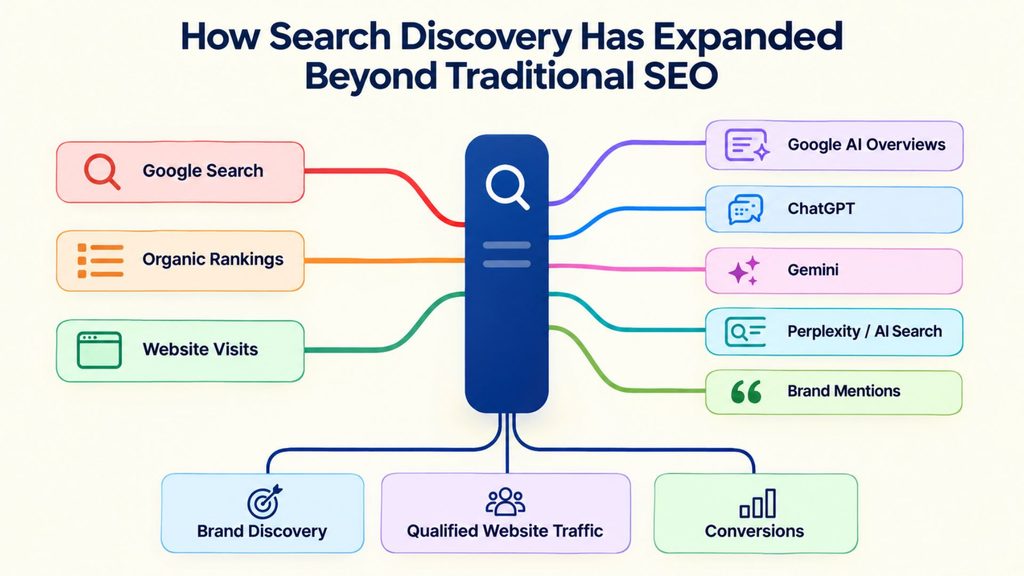
People now discover brands through Google AI Overviews, AI Mode, ChatGPT, Gemini, Perplexity, traditional search results, and other AI-powered search experiences that may answer a question before a website visit happens. 

For marketers, the goal is not to replace familiar SEO KPIs. It is to understand what happens before, during, and after the click. A brand can gain meaningful search visibility even when that exposure does not immediately generate an organic visit. 

Do Rankings and Clicks Still Matter in 2026? 

Yes. Keyword rankings, impressions, clicks, CTR, organic traffic, and conversions remain fundamental SEO performance metrics. 

Rankings indicate whether important pages are visible for relevant searches. Impressions measure how often those pages appear. CTR helps show whether search listings attract attention, while clicks reveal actual traffic acquisition. Conversions then connect organic visibility with leads, enquiries, sales, or other business outcomes.  

Google’s own guidance confirms that established SEO best practices continue to apply to AI Overviews and AI Mode. There are no separate technical requirements, or special AI-specific markup needed simply to become eligible for these features.  

So, the issue is not that traditional SEO KPIs are obsolete. The problem is relying on them alone.  

AI search measurement should extend the SEO reporting framework, not replace the metrics that already connect search performance with business results.  

Why Traditional SEO Reporting Is No Longer Enough 

Search journeys are no longer as straightforward as they once were. 

A user may discover a brand through a Google AI Overview, ChatGPT, Gemini, or another AI-powered search experience without visiting the website immediately. They might encounter the brand again later, search for it by name, visit the website directly, and convert at a different stage of the journey.  

This makes attribution more complex. The first interaction may contribute to awareness or brand discovery even when it does not generate the final click.  

Google’s Generative AI performance reporting in Search Console also reflects this shift by giving eligible properties greater visibility into impressions generated through AI Overviews and AI Mode.  

For SEO teams, this means reporting should look beyond traffic alone. Traditional metrics such as clicks, rankings, and conversions still matter, but they should be reviewed alongside broader indicators of search visibility, brand discovery, and AI-driven exposure.  

AI Search KPIs

The SEO KPIs That Still Matter 

Traditional SEO metrics remain the foundation of any useful performance report.  

Traditional KPI  What It Tells You 
Keyword Rankings  Where pages appear for relevant queries 
Search Impressions  How often the website appears in Search 
Organic Clicks  Traffic generated through organic search 
CTR  How effectively search listings attract clicks 
Organic Sessions  Website visits generated by organic channels 
Leads / Conversions  Business outcomes influenced by SEO 
Conversion Rate  How effectively organic traffic converts 

The key change is how these metrics are prioritized.  

Consider two pages: 

Page A 

  • 10,000 organic visits 
  • 20 leads 

Page B 

  • 3,000 organic visits 
  • 45 leads 

Page A generates more than three times the traffic, yet Page B produces more than twice the leads. If reporting focuses only on traffic growth, Page A may appear to be the stronger SEO asset.  

Business-focused SEO reporting should instead ask which visibility and traffic actually contribute to meaningful outcomes. This is also where conversion rate optimization becomes relevant: attracting visitors has limited business value if those users do not take meaningful actions.  

That same principle becomes even more important when adding AI search KPIs.  

The New AI Search KPIs to Track in 2026 

1. AI Search Impressions 

For properties with access to Google’s Generative AI performance report, marketers can measure how frequently links from their site appear within supported generative Search experiences.  

The current report covers AI Overviews and AI Mode and lets users analyze impressions over time and by dimensions including page, device, and country. Google is still rolling out the report, so it is not available to every Search Console property.  

AI impressions provide a useful visibility metric, but they should be evaluated alongside traditional Search impressions, traffic, and conversions.  

2. AI Citations 

An AI citation occurs when an AI-generated answer references or links to a website as a source.  

Relevant surfaces can include Google AI Overviews, AI Mode, ChatGPT Search, Gemini, and Perplexity.  

Citation tracking can reveal whether a brand’s content is being selected as supporting information for questions related to its expertise.  

However, not every platform offers a complete first-party citation report. Measurement may therefore require specialist AI visibility platforms, controlled prompt tracking, consistent query sets, and manual validation. 

The goal is not simply to count citations. It is to determine whether the brand appears for commercially and topically relevant questions. 

3. Brand Mentions in AI Answers 

A brand mention is different from a citation. 

An AI response could mention or recommend a company without linking directly to its website. 

For example: 

“Which SEO agencies specialize in AI search optimization in Dubai?” 

Tracking responses to this type of query can show whether AI systems associate a brand with the service categories it wants to own. 

Monitor whether AI answers: 

  • Mention the company 
  • Recommend it 
  • Associate it with relevant services 
  • Include it in competitor comparisons 

A mention does not prove that a conversion will follow, but it can indicate brand discovery and topical visibility. 

4. Entity Associations 

Modern SEO measurement should also examine what a brand is associated with, not just how many times it appears. 

For Gateway Marketing Digital, this means assessing whether search and AI platforms consistently connect the business with SEO, Dubai, performance marketing, generative engine optimization (GEO), answer engine optimization (AEO), and AI search optimization. 

This represents an entity-association framework.  

Marketers should assess whether search engines and AI systems consistently understand: 

  • Who the company is 
  • What services it provides 
  • Where it operates 
  • Which topics it has expertise in 

Strong entity associations can improve machine understanding, but they should not be treated as a guarantee of rankings, citations, or AI recommendations.  

5. Share of AI Answers 

“Share of AI answers” can be used as an internal visibility metric similar to share of voice.  

A simple calculation is to divide the number of relevant AI answers containing the brand by the total number of answers checked, then convert that figure into a percentage.  

If Gateway Marketing Digital appears in 18 out of 100 consistently tracked responses, its AI visibility share for that specific query set would be 18%.  

This is not an official Google metric.  

It becomes useful only when methodology stays consistent. Use the same query set, platforms, geography, language, and testing process when comparing one reporting period with another.  

Otherwise, the percentage can change simply because the measurement method changes.  

6. AI Referral Traffic 

Visibility is useful, but marketers should also measure when AI platforms actually send visitors to the website.  

Google Analytics introduced an AI Assistant channel in May 2026. Recognized traffic from AI assistants such as ChatGPT, Gemini, and Claude can be classified separately through the AI Assistant default channel grouping.  

Track: 

  • Sessions 
  • Engagement 
  • Leads 
  • Conversion rate 
  • Revenue 

AI referral traffic should be separated from broader AI visibility. A brand may appear frequently in AI answers while receiving relatively few direct clicks. 

7. Branded Search Growth and Assisted Conversions 

Not every AI interaction produces an immediate referral.  

Someone may see a business mentioned in an AI answer and later search for the brand name or combine the brand with a specific service.  

Useful supporting metrics include: 

  • Branded search impressions 
  • Brand-plus-service queries 
  • Direct traffic trends 
  • Returning users 
  • Assisted conversions 
  • Multi-touch conversion journeys 

These signals should be treated carefully. An increase in branded search after stronger AI visibility does not automatically prove that AI caused the increase.  

Use attribution data and consistent trend analysis before drawing that conclusion.  
 

How to Measure SEO and AI Search Performance 

Google Search Console 

Search Console remains the primary source for understanding organic Google Search performance.  

Track: 

  • Queries 
  • Impressions 
  • Clicks 
  • CTR 
  • Average position 
  • Landing pages 
  • Generative AI impressions where available 

Google’s dedicated Generative AI performance report currently focuses on impression visibility from AI Overviews and AI Mode and is being rolled out to a subset of properties.  

Traditional and generative visibility should therefore be reviewed together rather than treated as two unrelated SEO programs.  

Google Analytics 4 

GA4 helps connect search visibility with onsite behavior and business outcomes.  

Track: 

  • Organic sessions 
  • AI Assistant traffic 
  • Engagement 
  • Leads 
  • Conversion rate 
  • Revenue 
  • Multi-channel journeys 

Search Console explains how users encounter the site in Google Search. GA4 helps explain what users do after arriving.  

Used together, they provide a much stronger SEO measurement model.  

AI Visibility Monitoring 

Search Console and GA4 cannot provide complete cross-platform AI visibility.  

Specialist tools or controlled manual monitoring can help track: 

  • AI citations 
  • Brand mentions 
  • Competitor appearances 
  • Prompt-level visibility 
  • Entity associations 
  • Share of AI answers 

Use a fixed and representative set of queries. Randomly testing different prompts every month makes trend comparisons unreliable.  

Build a Modern SEO KPI Dashboard 

SEO KPI Dashboard

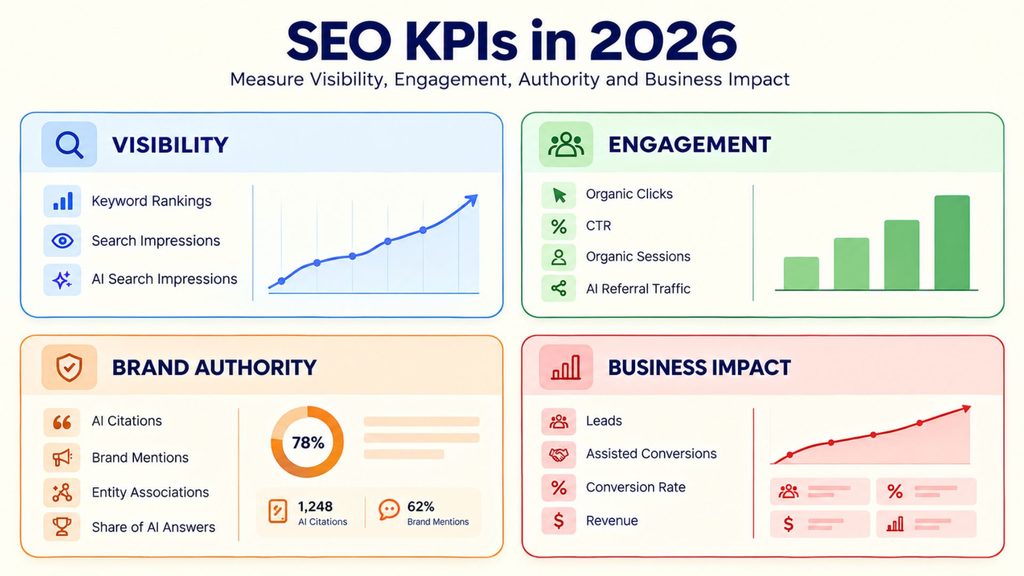
A practical SEO dashboard in 2026 can organize metrics into four layers.  

Layer  KPIs 
Visibility  Rankings, search impressions, AI impressions 
Engagement  Clicks, CTR, sessions, AI referral traffic 
Brand Authority  AI mentions, citations, entity associations, share of AI answers 
Business Impact  Leads, assisted conversions, revenue, conversion rate 

A useful dashboard should connect these four layers rather than treating them as isolated reporting categories. 

Visibility shows whether the brand is being discovered. Engagement shows whether visibility generates meaningful interaction. Brand authority provides context around how the business is understood and referenced, while business-impact metrics determine whether the activity contributes to leads, conversions, and revenue.  

This model prevents teams from stopping at vanity metrics. Ultimately, SEO performance should connect back to measurable business impact.  

Final Takeaway 

SEO measurement in 2026 needs to move beyond rankings and clicks without abandoning them. Rankings, search visibility, AI citations, brand mentions, referral traffic, conversions, and revenue each reveal a different part of the search journey.  

The strongest reporting model connects those signals instead of viewing them separately. Gateway Marketing Digital can help businesses combine traditional SEO performance with emerging AI-search visibility and turn that data into a measurable search strategy.  

Read More

Certified partners