Lead Generation Cost in Dubai: What Actually Drives It
What You Will Learn
Lead generation cost in Dubai is set by four things: the channel, the offer, how hard the form qualifies people, and how fast your team follows up. The same budget can produce leads at AED 53 or at AED 280 depending on those four choices. What matters is not the cheapest lead but the cost of a lead that turns into a viewing, a booking or a sale.
Gateway Marketing Digital has run lead generation for UAE businesses since 1997. Below we break down what pushes the cost per lead up or down in Dubai, with real figures from campaigns we have published as case studies, and how to judge whether a quote you have been given makes sense.
What decides lead generation cost in Dubai?
There are two costs to look at. The first is media cost: what Meta or Google charges you to reach people and get them to raise their hand. The second is the cost of the system around the ads: landing pages, creative, tracking, the lead sheet or CRM, and the people who call leads back. A low media cost with a weak system still produces expensive customers, because most of the leads go nowhere.
So the useful number is cost per qualified lead, and after that cost per sale. Any lead generation cost in Dubai should be read next to those two figures.
1. Which channel brings the lead in?
Meta ads (Facebook and Instagram) create demand: you reach people before they search, so leads are usually cheaper but colder. Google Search captures people already looking, so clicks cost more but intent is higher. WhatsApp sits on top of both, and in the UAE it often decides quality.
On the Dubai Jewel Tower launch for Rocky Real Estate, 44% of WhatsApp leads qualified, against 11% of Meta lead form leads. The form leads were cheaper to buy. The WhatsApp leads were far cheaper per qualified buyer.
2. How valuable and how clear is the offer?
A specific offer with one clear next step costs less per lead than a general brand message. A free masterclass, a property brochure or a consultation gives people a reason to act now. For coaching brand Anita Milovac, a masterclass funnel we built brought in 372 leads at AED 6.58 each, about a third below the target set before launch, because the offer itself was the first taste of the coaching.
High-value purchases cost more per lead, and that is fine. A Dubai property buyer or a three-month meal plan subscriber is worth thousands of dirhams, so the business can afford to pay more for each serious enquiry.
3. How much does the form qualify people?
Every question you add to a form raises the cost per lead and lowers the number of leads. It also removes time wasters. For Simply Healthy Diets, the landing page form asked for the plan wanted, days per week and the main goal before contact details. The campaign produced 164 qualified enquiries in five months, and at least 6.7% became clients worth AED 7,000 to 8,000 each.
The rule we use: qualify harder when your sales team is small or your product is expensive, and qualify lightly when volume matters and follow-up is automated.
4. What is the campaign told to optimise for?
Meta and Google find more of whatever you tell them counts as a result. If that is a form fill, they find form fillers. If your real outcomes (qualified, viewed, booked, paid) are sent back to the platforms, they learn to find buyers. Google calls this offline conversion import, and Meta has the Conversions API for the same job.
When the Dubai Jewel Tower campaigns were judged on qualified rate instead of raw volume, cost per lead fell 41% within a month, from AED 176 to AED 103, while the qualified rate rose from 22.4% to 31.8%. In the second phase the campaigns delivered about 944 leads at about AED 53 each, around 81% below the approved target of AED 280.
5. How fast does someone call the lead back?
Follow-up speed does not change the price you pay Meta for a lead. It changes how many of those leads you keep. A lead called within the first hour is far more likely to book than one called the next day, so slow follow-up quietly doubles your real cost per sale. Instant alerts to the sales team and a lead sheet that tracks every contact attempt are part of the cost, not an extra.
6. How competitive is your market in the UAE?
Dubai real estate, finance and premium services compete with many advertisers for the same audiences, especially in peak seasons, so media costs rise. Niche B2B offers often have fewer competitors in the auction but smaller audiences. Seasonality matters too: Ramadan, summer and year-end all shift costs in the UAE, which is why campaigns are planned a quarter ahead.
How do lead generation companies charge?
You will see three models in Dubai. Each one moves the risk to a different side of the table.
Monthly management fee plus ad spend: you own the ad accounts and pay the platforms directly. Most transparent, and you keep all the data.
Pay per lead: predictable on paper, but the provider is rewarded for volume, so define a qualified lead in writing first.
Performance or commission: the provider is paid on sales. Fair when sales tracking is reliable, risky when it is not.
Whichever model you pick, ask who owns the leads, the ad accounts and the pixel. We cover that in more detail on our lead generation agency in Dubai page.
How to judge a lead generation cost in Dubai before you spend
Work out what a customer is worth to you over the first year.
Estimate your close rate from a qualified lead (your sales history is the best guide).
Divide the acquisition cost you can afford by the leads needed per sale. That is your ceiling cost per qualified lead.
Compare any quote or target against that ceiling, not against what another business pays.
For high-value buyers, the maths usually allows a higher cost per lead than people expect. Our post on high-ticket lead generation in the UAE walks through that side.
FAQ: lead generation cost in Dubai
What is a good cost per lead in Dubai?
It depends on what a customer is worth. Across our published campaigns, cost per lead ranged from AED 6.58 for a coaching masterclass to about AED 53 to AED 149 for Dubai property. Judge it against your qualified rate and close rate, not against another industry.
Are cheap leads a bad sign?
Not always, but check them. Cheap lead form leads often qualify at a lower rate: on one Dubai property launch, 11% of form leads qualified against 44% of WhatsApp leads. Look at the cost per qualified lead before you celebrate a low cost per lead.
How long before the cost per lead settles?
Expect the first two to four weeks to be the most expensive while the platforms learn. On the Dubai Jewel Tower launch, cost per lead fell 41% within the first month once budget moved to the channels producing qualified buyers.
Should I pay per lead or pay a monthly fee?
A monthly fee with ad accounts in your name keeps the data and the learning with you. Pay per lead can work for simple offers, but only with a written definition of a qualified lead and the right to reject leads that do not meet it.
Next step
The right lead generation cost in Dubai is the one your sales maths can carry, measured on qualified leads and sales. If you want us to look at your current cost per lead and where it leaks, contact our team.
If you want to know how to rank in ChatGPT, the short answer is this: ChatGPT recommends businesses it can read, that answer the exact question clearly, and that other trusted sites already mention. You cannot buy a place inside the answer and there is no single trick. You earn it through crawl access, pages worth quoting and third-party proof.
Gateway Marketing Digital is a Dubai marketing agency, working since 1997, that now runs AI SEO, also called generative engine optimisation (GEO) or answer engine optimisation (AEO). Every month we ask ChatGPT, Perplexity and Gemini the questions buyers in Dubai actually type, such as “Which is the best Google Ads agency in Dubai?”, and record who gets named and which sources are cited. This guide is built on what those checks show.
How does ChatGPT decide which businesses to recommend?
When ChatGPT searches the web for an answer, it reads a small set of pages and builds its reply from them. So the real question is not only “is my website good?” but “which pages does the AI read for this question, and am I on them?”
For buying questions the answer is often a third-party page. In our October 2026 check of 16 AI answers to eight questions about Dubai agencies, Sortlist was cited in 6 answers and Semrush’s agency directory in 5, with “top agencies in Dubai” list articles close behind. The businesses named in the answers were largely the ones listed on those pages. Your own website matters, but on its own it is rarely enough.
The trap is that robots.txt can allow these crawlers while a firewall, hosting security rule or Cloudflare bot setting still blocks them with a “403 forbidden” response. Ask your developer to test each crawler against your live site and check the firewall logs, not just read robots.txt. Add an llms.txt file too: a plain text summary of who you are and your key pages.
2. Does your site answer the buyer’s exact question?
AI answers lift short, direct statements. Put the answer in the first two or three sentences of the page, then the detail. Use headings phrased the way people ask (“How much does…”, “Which agency is best for…”, “How to choose…”) and finish with an FAQ that gives clear, complete answers. Mark the FAQ up with FAQ schema so machines can read the questions and answers as a list.
Classic search rankings still matter, because AI tools that search the web read pages that already rank. In Search Console, our own generative engine optimisation services page moved from an average position of 22.6 to 2.2 for “generative engine optimization services in dubai” between the two most recent 28-day periods. A page in the top three is a page AI tools are far more likely to read.
3. Are you listed where AI tools look for answers?
For “best X in Dubai” questions, AI tools lean on directories, review platforms and list articles. For an agency that means profiles on Sortlist, Clutch, DesignRush and Semrush Agency Partners. For a restaurant, retailer or property business the sources differ, but the pattern is the same. Run the question yourself in ChatGPT and Perplexity, note every source cited, and work through that list:
Create or complete the profile, with every service and location filled in.
Ask real clients for reviews on the platforms that get cited.
Contact the authors of “top businesses in Dubai” articles with evidence of your results and ask to be considered.
Keep your Google Business Profile complete and active, with fresh reviews.
4. Are your business facts the same everywhere?
AI tools match a business across sources by its facts. If your name, address, phone number, founding year or service list differ between your website, Google Business Profile, LinkedIn and directories, the AI is less sure they describe the same business. Pick one version and use it everywhere. For us that is Gateway Marketing Digital, Al Hamriya, Bur Dubai, since 1997.
5. Do you give AI something real to quote?
Specific beats impressive. Named results, dates, revenue figures and clear service details get quoted; claims such as “the best agency in Dubai” get ignored, and you should never make them about yourself. Show the evidence and let the AI draw the conclusion.
A real example: in our 19 October 2026 check, Perplexity cited our Meta ads page when asked “Which agency is best for Meta ads in Dubai?”. That page publishes named client results with revenue and return on ad spend figures, which gives an AI tool something concrete to repeat. Pages that only list services rarely get that treatment.
6. How do you measure whether you rank in ChatGPT?
There is no Search Console for ChatGPT, so build your own scoreboard:
Write down around 10 questions a buyer asks just before choosing a business like yours, buying questions first.
Ask each one in ChatGPT, Perplexity and Gemini once a month.
Record whether you are mentioned, whether your site is cited, and who is cited instead.
Check referral visits from chatgpt.com and perplexity.ai in Google Analytics.
The “cited instead” column is the most useful one: it is your to-do list of directories, articles and review sites to win next. Pair it with the search metrics in our guide to SEO KPIs beyond rankings and clicks.
What does not work?
Repeating “ChatGPT” or “AI” across your pages. Being cited depends on answers and proof, not keywords.
Publishing large volumes of generic AI-written articles with no real data in them.
Fake or paid reviews. Platforms remove them and they damage trust in every other source.
Calling yourself “No. 1” without evidence anyone else can check.
FAQ: how to rank in ChatGPT
Can I pay to be recommended by ChatGPT?
No. The businesses ChatGPT names inside an answer come from the sources it reads, not from payment. What you can invest in is the work that puts you on those sources: crawl access, clear answer pages, directory profiles, reviews and list inclusions.
How long does it take to rank in ChatGPT?
Fixing crawl access and completing directory profiles can show up within weeks, once those pages are crawled again. Earning mentions in list articles, reviews and higher search rankings usually takes a few months. Measure monthly so you can see which changes moved the answers.
Is ranking in ChatGPT different from normal SEO?
They overlap heavily. Good SEO gets your pages read; AI optimisation makes sure those pages answer questions directly, that your facts match across the web, and that third-party sites mention you. Most businesses need both, run as one plan.
Does ChatGPT recommend local Dubai businesses?
Yes. When a question names Dubai or the UAE, ChatGPT and Perplexity look for sources about businesses in that location. Clear location details on your site, a complete Google Business Profile and listings on UAE directories all help the AI connect your business to the city.
Next step
Learning how to rank in ChatGPT is mostly about being easy to read, easy to quote and easy to verify. If you want to know where your business stands today, see how our ChatGPT SEO services work inside our wider plan as an AI SEO agency in Dubai, or contact our team and we will run your buying questions through the main AI tools.
WordStream’s 2026 benchmark reviewed 13,474 US-based search advertising campaigns across 23 industries. It reported a median cost per click of $5.42, conversion rate of 8.18%, and cost per lead of $66.69. These are broad US benchmarks, not UAE-specific targets, but they show why clicks and low-cost leads cannot be treated as proof of profitable growth.
Growth marketing services fix failing campaigns by locating bottlenecks across the customer journey, connecting campaign activity with CRM and sales outcomes, improving conversion paths, and testing changes against qualified leads, customers, retention, and revenue. The objective is not simply to generate more submissions. It is to improve the commercial value produced by the marketing system.
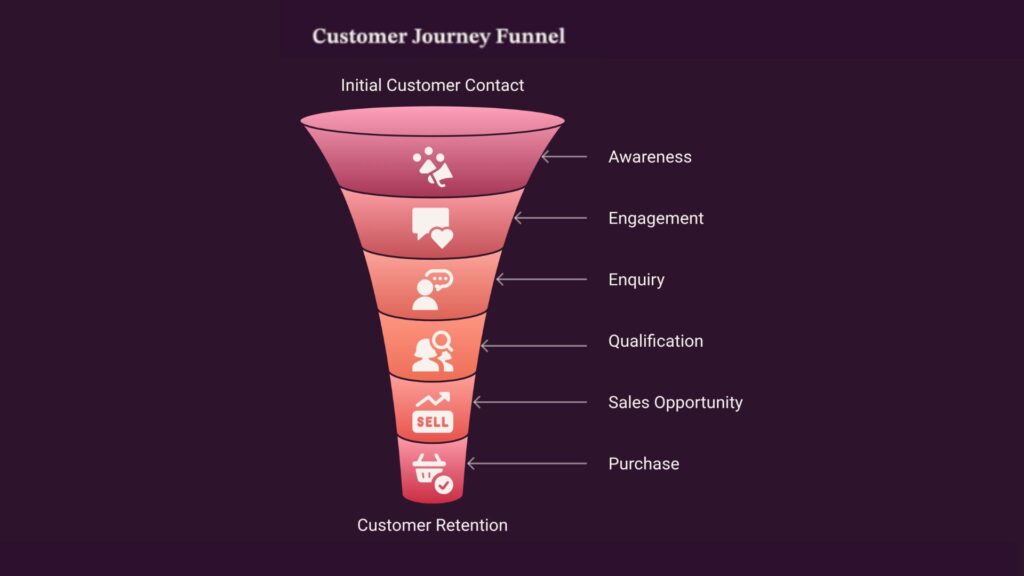
A campaign may look efficient inside Google Ads, Meta Ads, or GA4 while losing prospects through weak landing pages, poor qualification, slow sales follow-up, or low retention. Campaign recovery therefore requires a full-funnel view.
Key Highlights
Campaign recovery begins with full-funnel diagnosis, not isolated channel changes.
Clicks and leads must be evaluated against opportunities, customers, and revenue.
The highest-impact bottleneck should be fixed before minor optimizations.
Controlled experiments replace assumptions with measurable evidence.
Scaling before fixing conversion problems can multiply wasted spend.
Scaling before fixing conversion problems can multiply wasted spend.
Signs of a Failing Marketing Campaign
Campaign Performance Warning Signs
Common warning signs include:
Rising cost per lead
Declining return on ad spend
Poor lead quality
Low lead-to-customer conversion rates
High landing-page abandonment
Traffic growth without corresponding revenue
Low retention or repeat purchases
Inconsistent performance across channels
Dependence on one acquisition platform
These metrics must be interpreted together. A higher cost per lead may be acceptable when sales conversion improves, while a lower cost per lead may be harmful when broader targeting attracts unsuitable enquiries.
When the Campaign Is Not the Main Problem
Poor results are not always caused by advertising settings. Weak demand, unsuitable pricing, unclear positioning, limited differentiation, or an unconvincing offer can reduce performance even when the campaign is technically sound.
Campaign execution failure concerns audiences, keywords, creatives, bids, or placements. Funnel failure occurs when relevant prospects encounter weak pages, poor qualification, or slow follow-up. Product-market or offer failure means the proposition itself does not give the intended audience a strong reason to buy.
The Limitations of Traditional Campaign Optimization
Overreliance on Channel-Level Metrics
Clicks, impressions, traffic, reach, and low-cost leads measure activity rather than growth. A campaign may reduce cost per lead by widening its targeting, yet most enquiries may lack the budget, location, urgency, or authority required by sales. The campaign looks efficient while cost per qualified opportunity worsens.
Hidden Problems Across the Customer Journey
Weak landing-page messaging, disconnected CRM data, inconsistent qualification, slow sales response, and ineffective nurturing can remain hidden behind good advertising metrics. Changing bids or creatives cannot repair a broken handoff between marketing and sales.
The Risks of Scaling Too Early
Increasing budgets before fixing targeting, conversion, and lead-management problems usually generates more of the same waste. Scaling should begin only after the business can show a repeatable link between spend, qualified opportunities, customers, and revenue.
How Growth Marketing Services Diagnose Campaign Problems
Acquisition and Campaign Audit
The audit reviews Google Ads, Meta Ads, SEO, email, referrals, keywords, search terms, targeting, creatives, budgets, bidding strategies, placements, and conversion settings. Growth teams look for wasted spend, intent mismatch, audience overlap, creative fatigue, and inaccurate conversion signals.
Broad search terms may generate submissions but few sales, while low-cost social lead forms may attract users with little purchase intent. The audit determines which channels and campaign elements contribute to qualified demand rather than surface-level activity.
Landing-Page and Conversion Analysis
Landing-page analysis compares the advertisement’s promise with the post-click experience. Teams review headlines, speed, mobile usability, structure, forms, calls to action, trust signals, and tracking.
Irrelevant visitors may indicate poor targeting. Relevant visitors who engage but do not convert may indicate a weak offer, insufficient proof, unclear messaging, or unnecessary form friction.
Relevant traffic may leave because the page is generic, qualified enquiries may stall because responses are slow, and customers may not return when onboarding or retention is weak. Mapping these transitions makes it easier to identify the stage that limits the wider campaign.
CRM and Sales Data Integration
Reliable diagnosis connects GA4, Google Ads, Meta Ads, form submissions, call tracking, lead scores, CRM stages, and closed revenue. GA4 provides attribution-path reporting, Google Ads supports importing offline conversions, and Meta supports CRM connections for qualified-lead optimization. s connection helps distinguish a basic form submission from a qualified lead, customer, or revenue event. It also prevents campaign platforms from treating every enquiry as equally valuable.
Funnel Bottleneck Prioritization
Problems should be ranked by expected impact, effort, confidence, revenue potential, and data requirements. An impact-confidence-effort model keeps prioritization practical.
A broken conversion event usually matters more than a headline test because unreliable tracking affects every later decision. Similarly, slow sales response may deserve priority when landing-page conversion is already strong but qualified leads are not progressing.
How Growth Marketing Services Fix Failing Campaigns
Building a Full-Funnel Marketing Strategy
A full-funnel marketing strategy connects paid media, SEO, content, email, remarketing, landing pages, sales follow-up, onboarding, retention, and referrals around measurable outcomes.
If qualified leads are lost because sales replies take two days, faster CRM routing, response alerts, WhatsApp acknowledgement, and nurturing may improve results more than additional ad spend. Every stage must support the next rather than operate as an isolated activity.
Improving Acquisition Through Performance Marketing
Performance marketing services improve acquisition through search-intent alignment, audience segmentation, negative keywords, creative and offer testing, remarketing, accurate tracking, and CRM-based budget allocation.
The cheapest click or lowest cost per lead is not always the best result. A higher-cost campaign may be more valuable when it produces stronger purchase intent, larger transactions, or greater customer lifetime value. WordStream’s 2026 analysis also notes that higher CPC can be worthwhile when traffic converts effectively.
Budget should therefore move toward campaigns that generate qualified opportunities and customers, even when their initial traffic costs are higher.
Improving Landing-Page Performance Through CRO
Conversion rate optimization is the structured process of improving the percentage and quality of visitors who complete a valuable action.
Growth teams test headline clarity, message matching, page speed, calls to action, form length, trust signals, mobile usability, social proof, and offer clarity. GA4, heatmaps, session recordings, customer feedback, and A/B testing help identify friction.
CRO should increase qualified conversions, not merely make forms easier to submit. Removing qualification questions may increase lead volume while reducing sales value.
Strengthening Lead Generation and Qualification
A stronger lead generation strategy connects targeting, offers, qualification questions, lead scoring, CRM routing, response time, nurturing, and sales feedback. Marketing and sales also need a shared definition of a qualified lead.
A consultation, calculator, audit, assessment, or sector guide can create a clearer reason to respond than a generic “Contact Us” form. The offer must match the visitor’s intent and funnel stage. High-intent search visitors may be ready for a consultation, while early-stage audiences may need educational content before speaking with sales.
Using Growth Experimentation to Improve Performance
Growth experimentation follows a disciplined process:
Identify the highest-impact bottleneck.
Develop a measurable hypothesis.
Select one primary success metric.
Run a controlled test.
Analyze the result.
Document the learning.
Scale, revise, or stop the experiment.
A team might test a consultation-focused page against a generic service page or compare a high-intent Google Search campaign with a broader Meta lead campaign.
Results should be judged through qualified-lead rate, opportunity creation, customer acquisition cost, and revenue potential rather than lead volume alone. A test that produces fewer but better-qualified leads may be more valuable than one that produces many low-intent submissions.
Adapting Growth Marketing Campaigns for the UAE Market
Providers offering growth marketing services UAE businesses can use must account for regional audiences, languages, communication preferences, and industry-specific buying journeys. UAE localization involves campaign design, not simply adding “Dubai” or “UAE” to ad copy.
Geographic and Audience Segmentation
Dubai, Abu Dhabi, Sharjah, and other emirates can differ in customer concentration, competition, and service availability. Residents, expatriates, tourists, and international investors may also have different needs and decision timelines.
Location-specific campaigns, budgets, landing pages, and offers can improve relevance and measurement. Nationwide targeting remains suitable when service coverage and conversion data support it.
Language, Device and Communication Preferences
Campaigns may require English and Arabic messaging, mobile-first pages, WhatsApp enquiries, click-to-call options, and fast acknowledgement. The appropriate mix depends on the intended customer segment rather than assumptions about all UAE users.
Language should remain consistent from advertisement to landing page and sales follow-up. Mobile and WhatsApp workflows should also preserve lead qualification rather than treating every enquiry as equally valuable.
Industry-Specific Campaign Requirements
Real estate, healthcare, education, e-commerce, professional services, and business setup campaigns have different compliance needs, qualification criteria, sales cycles, and conversion paths.
A property campaign may qualify prospects by budget, location, financing needs, and purchase timeline. An e-commerce campaign can optimize more directly toward purchases and repeat transactions. A healthcare campaign may require more careful messaging, trust signals, and appointment qualification.
Targeting, offers, tracking, and follow-up should reflect the industry and intended audience.
Metrics That Measure Campaign Recovery
Funnel Stage
Key Metrics
What the Metrics Reveal
Awareness
Impression share, reach
Whether the intended audience can see the campaign
Engagement
Click-through rate, cost per click
Whether messaging attracts relevant attention
Landing page
Conversion and form-completion rates
Whether the page supports visitor intent
Lead generation
Cost per qualified lead
Whether acquisition produces suitable prospects
Sales pipeline
Lead-to-opportunity and lead-to-customer rates
Whether leads progress commercially
Acquisition
Customer acquisition cost
Total cost required to acquire a customer
Revenue
Return on ad spend, marketing-sourced revenue
Whether marketing produces measurable income
Retention
Retention and repeat purchase rates
Whether customers continue generating value
Long-term value
Customer lifetime value
Expected value of the customer relationship
Acquisition Metrics
Impression share, click-through rate, cost per click, and cost per qualified lead help diagnose visibility and acquisition efficiency. They provide useful early indicators but do not confirm sales impact.
Conversion and Sales Metrics
Landing-page conversion rate, form-completion rate, lead-to-opportunity rate, lead-to-customer rate, and customer acquisition cost show whether traffic becomes commercially useful.
These metrics help reveal whether the problem occurs before the form submission, during qualification, or within the sales process.
Revenue and Retention Metrics
Return on ad spend, marketing-sourced revenue, retention rate, repeat purchase rate, and customer lifetime value reveal whether growth continues after acquisition.
Retention and customer value matter because a campaign with a higher acquisition cost may still be profitable when it attracts customers who purchase repeatedly or remain with the business for longer.
Why Isolated Metrics Can Be Misleading
Consider a hypothetical comparison. Campaign A produces cheaper leads, but few meet the sales criteria. Campaign B produces more expensive leads, yet a larger percentage becomes qualified opportunities and customers.
Campaign A appears stronger in a basic advertising report. Campaign B may deliver higher revenue and a lower effective customer acquisition cost. The final decision should be based on commercial outcomes rather than lead cost alone.
When Growth Marketing Support Is Needed
Performance Warning Signs
Rising acquisition costs, declining campaign performance, inconsistent lead quality, low landing-page conversion rates, difficulty scaling, platform dependence, repeated inconclusive tests, and traffic growth without revenue are common signals.
Professional support becomes more valuable when paid media, landing pages, CRM processes, sales follow-up, and retention all require coordination. These issues are difficult to resolve when each team only reviews its own metrics.
Tracking and Attribution Warning Signs
Support may be needed when decision-makers cannot identify which campaigns generate qualified opportunities, where leads leave the funnel, whether sales follow-up affects results, or which audiences deserve more budget.
GA4 attribution reporting and offline conversion imports can connect more of the customer journey when tracking is configured correctly. strongest signal is often a lack of visibility. Increasing budgets becomes difficult to justify when the business cannot connect campaign spending with opportunities, customers, and revenue.
Conclusion
Campaign recovery depends on solving the most important constraint first. That may be poor targeting, an unclear offer, inaccurate tracking, weak qualification, or slow sales response. Before increasing advertising budgets, businesses should audit the complete funnel. More traffic cannot repair a broken conversion or sales process. Sustainable improvement begins with measurable evidence and ends with qualified customers and revenue.
If your business needs a structured approach to campaign recovery, Gateway Marketing Digital can help identify funnel gaps, improve campaign efficiency, and create a clearer path from marketing investment to measurable revenue through our revenue growth services. To discuss your business goals with our experts, contact us today and discover how data-driven strategies can accelerate your growth.
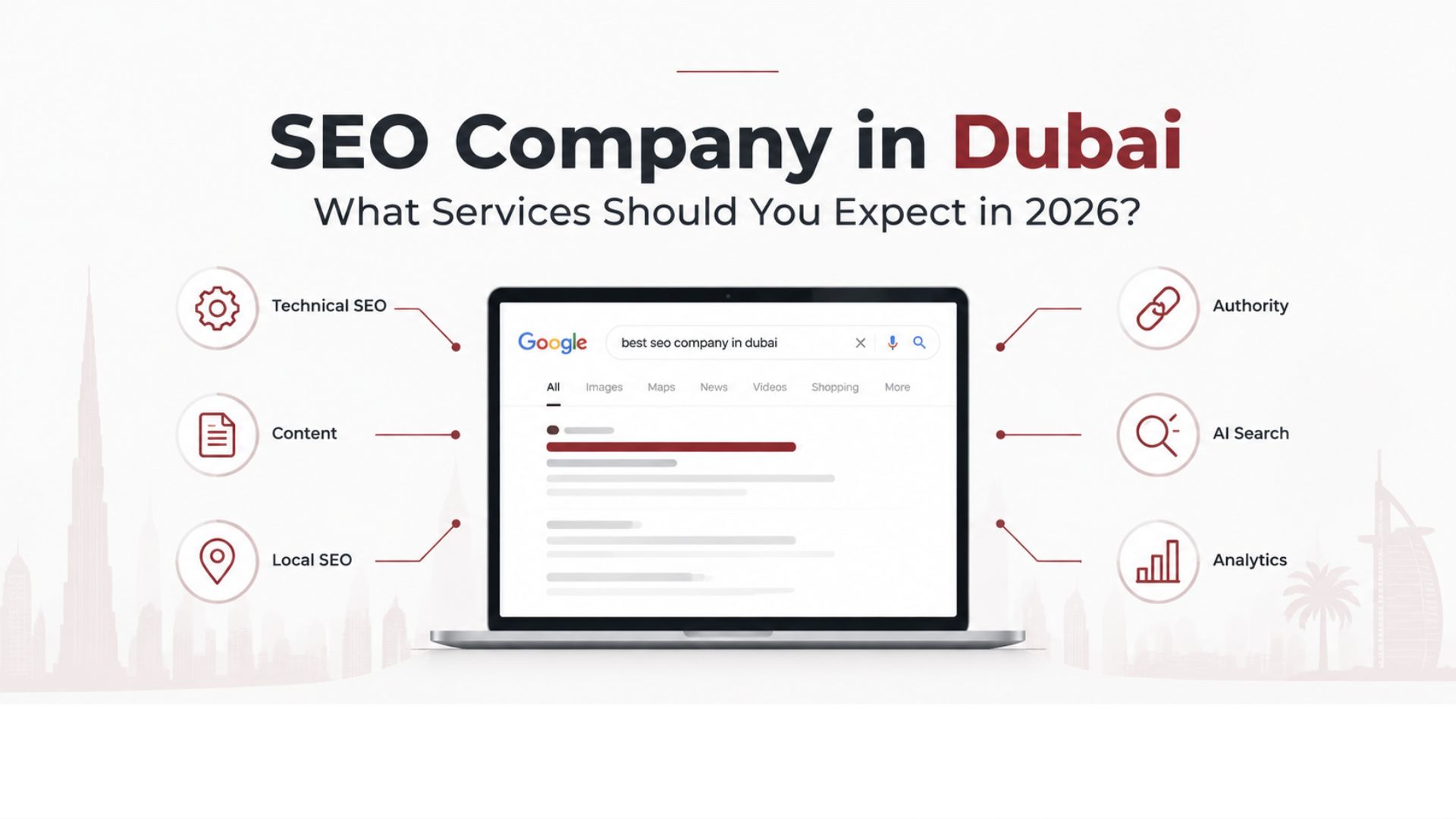
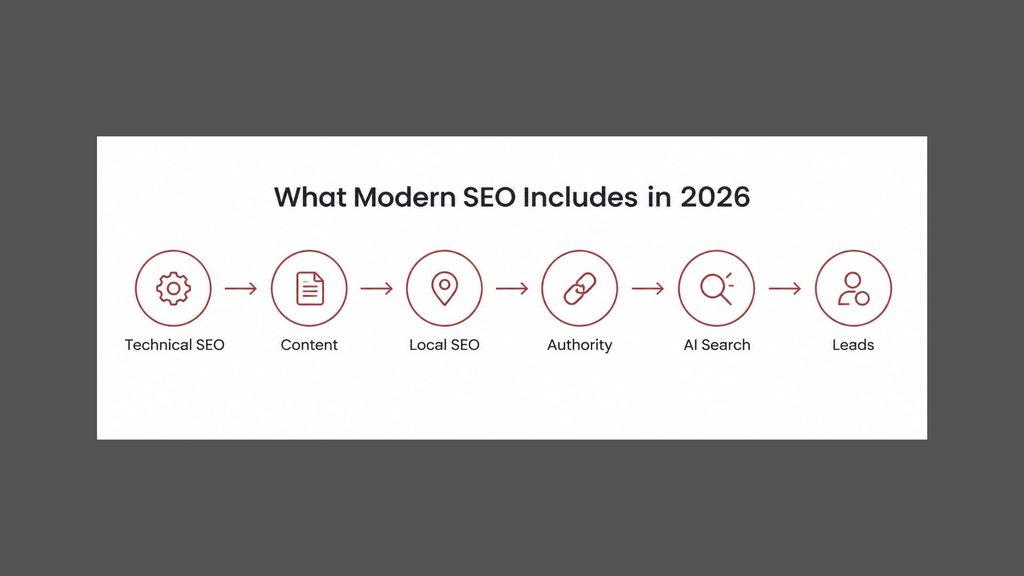
SEO in Dubai in 2026 is no longer just about getting a website onto page one. Businesses need organic visibility that attracts the right audience, supports enquiries, and contributes to measurable growth. That requires strong technical foundations, useful content, local search visibility, authority, and increasingly, visibility across AI-powered search experiences.
A capable SEO company in Dubai should therefore work beyond keyword positions. Modern Dubai SEO services need to account for a multilingual audience, competitive commercial searches, Google Maps, mobile performance, and the way platforms such as Google AI Overviews, ChatGPT, Gemini, and Perplexity surface information.
What Does an SEO Company in Dubai Actually Do?
An SEO company helps a business improve how easily potential customers can discover it through organic search. The work typically combines technical website improvements, keyword and search-intent research, content optimization, local SEO, authority building, analytics, and conversion tracking.
In Dubai, this also means understanding local search behavior. A person searching for a nearby service may interact with Google Maps before organic listings, while a B2B buyer may research several providers before making an enquiry.
The goal should not be to report a collection of ranking improvements every month. A good SEO service company in Dubai should connect increased search visibility with qualified visits, enquiries, leads, and ultimately business outcomes.
7 SEO Services You Should Expect in 2026
1. Technical SEO and Website Audits
SEO starts with making sure search engines can efficiently access, understand, and index a website. A technical SEO audit reviews crawlability, indexation, canonical tags, redirects, site architecture, XML sitemaps, structured data, mobile usability, and other technical elements.
Core Web Vitals and page performance should also be reviewed, particularly for mobile visitors. Schema markup can help search engines understand entities, services, products, locations, and other page information more clearly.
Technical SEO Dubai services should result in prioritized fixes rather than a long audit document with no implementation plan.
2. Keyword Research and Search Intent Mapping
Keyword research should identify more than phrases with high search volume. It should establish why people search and which page should satisfy that intent.
For example, someone researching “how SEO works” has different needs from someone looking for an SEO services company in Dubai. Informational, commercial, transactional, and local searches require different content formats.
Research should also account for Dubai and UAE modifiers, service variations, long-tail searches, and relevant Arabic queries. Each important keyword cluster should be mapped to the most appropriate URL. This helps prevent keyword cannibalization, where several pages compete for essentially the same intent.
3. On-Page SEO and Content Optimization
On-page SEO improves how clearly a page communicates its subject and purpose to users and search engines. It includes page titles, meta descriptions, headings, internal links, image optimization, semantic entities, content structure, and contextual relevance.
Content should then answer the actual questions behind the search. A service page targeting commercial intent, for instance, should help a buyer understand the service, process, suitability, evidence, and next steps rather than simply repeat a target keyword.
Strong content also needs a clear structure that makes key information easy to extract and understand, which is increasingly useful for both traditional search engines and AI-driven discovery systems.
4. Local SEO and Google Business Profile Optimization
For businesses serving customers in specific parts of Dubai, local search can be as important as conventional organic rankings.
Local SEO Dubai work can include Google Business Profile optimization, accurate business details, appropriate categories, reviews, local citations, location-specific pages, and NAP consistency across relevant platforms.
Google Maps SEO Dubai also requires attention to the information customers see before they visit a website. Business descriptions, services, photos, reviews, operating details, and profile accuracy can all influence how effectively a business converts local visibility into calls, directions, and enquiries.
5. Link Building, Digital PR and Authority
Off-page SEO should focus on building credible authority rather than accumulating as many backlinks as possible.
Useful signals can come from relevant editorial links, industry publications, UAE media, trusted directories, digital PR, and genuine brand mentions. The relevance and credibility of a referring website usually matter more than raw link quantity.
Businesses should be cautious when SEO companies promise hundreds or thousands of links every month. Bulk backlinks, private blog networks, spam directories, and low-quality paid link packages can create risk without building meaningful authority.
A sustainable strategy focuses on earning references that make sense for the business, its industry, and its audience.
6. Arabic SEO and UAE Search Localization
Arabic SEO should not be treated as simply translating an English page word for word.
People can describe the same product or service differently across languages and markets. Effective Arabic SEO Dubai work therefore starts with native keyword research and search-intent analysis before content is localized.
Businesses operating in both English and Arabic may also need appropriate site architecture and hreflang implementation so search engines understand which version should appear for different users.
This becomes even more important when a Dubai business expands across the GCC, where audience behavior, terminology, competition, and search demand can vary by country.
7. AI SEO, AEO and GEO
Search discovery is expanding beyond conventional results pages.
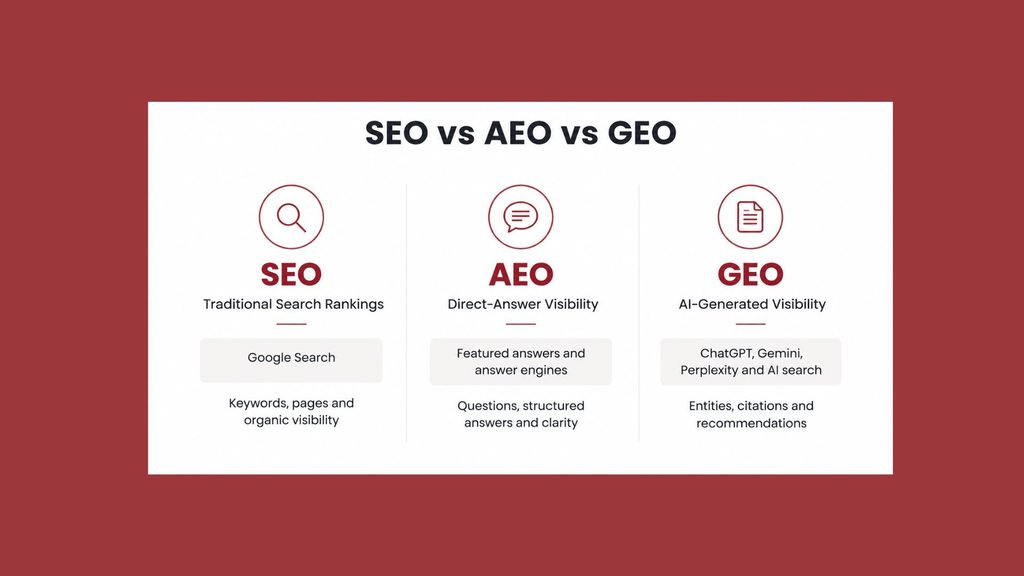
SEO focuses primarily on organic search visibility. Answer Engine Optimization (AEO) helps make information easier to understand and retrieve for direct-answer experiences. Generative Engine Optimization (GEO) focuses on how brands and content can be understood, cited, or recommended by generative AI systems.
Platforms such as Google AI Overviews, ChatGPT, Gemini, Perplexity, and Copilot have made this an additional visibility layer for businesses to consider.
AI SEO should complement strong traditional SEO rather than replace it.
What Should Your SEO Company Measure?
Keyword positions remain useful, but they should not be the entire monthly report. Businesses need to understand whether search visibility is producing meaningful commercial activity.
Metric
What It Shows
Organic clicks
Search traffic growth
Qualified traffic
Relevance of visitors
Leads and enquiries
Business impact
Conversion rate
Traffic effectiveness
Commercial keyword visibility
Buyer-intent performance
Local visibility
Google Maps performance
AI visibility
Mentions or citations in AI platforms
Google Search Console can show queries, impressions, clicks, and landing-page performance, while Google Analytics 4 and conversion tracking help explain what visitors do after arriving.
Ideally, reporting should connect the journey from query → landing page → session → lead → conversion.
How Much Do SEO Services Cost in Dubai?
There is no single SEO price that applies to every Dubai business because the amount of work required can differ significantly.
Website size is one factor. A small service website has very different technical and content requirements from an ecommerce store containing thousands of URLs. Competition also matters because entering a highly contested commercial category may require more content development and authority building.
Other factors include the number of locations being targeted, existing technical problems, content requirements, link acquisition, Arabic and English optimization, and whether the campaign targets Dubai, the UAE, or several GCC markets.
This is why businesses should compare the scope behind an SEO proposal rather than choosing solely by monthly price. Two similarly priced packages may include very different levels of strategy, implementation, content, and reporting.
How to Choose the Right SEO Company in Dubai
Before hiring an SEO company, ask questions that reveal how the work will actually be delivered:
Can the company demonstrate relevant SEO results?
Who will work on the account after the sales process?
Is technical SEO handled internally?
How are backlinks and brand mentions earned?
Can the team support Arabic search optimization?
Does reporting connect SEO activity with leads and conversions?
Can the company clearly explain its approach to AI SEO, AEO, and GEO?
What is included and excluded from the monthly scope?
Watch for warning signs as well. Guaranteed number-one rankings should be treated cautiously because no SEO provider controls Google’s ranking systems. Other red flags include bulk backlink promises, reports containing only rankings, missing conversion tracking, and identical packages for businesses with very different needs.
AI-search services should receive similar scrutiny. Ask what is actually measured and how the work differs from the company’s existing SEO process.
What Makes SEO in Dubai Different?
Dubai combines several search audiences within one market. English is widely used for commercial searches, while Arabic can be important for reaching different customer segments. The city’s expatriate population adds further variation in how people research and compare businesses.
Local intent is also significant. For many services, Google Maps and location-specific searches can influence discovery alongside traditional organic listings.
Competition can be particularly strong in sectors such as real estate, healthcare, ecommerce, hospitality, finance, and professional services.
Businesses expanding beyond Dubai also need to distinguish between Dubai-specific, wider UAE, and GCC search intent rather than assuming that one set of pages and keywords will perform equally across every market.
Final Takeaway
A modern SEO company in Dubai should bring together technical SEO, intent-led content, local optimization, authority building, Arabic search expertise, analytics, conversion tracking, and AI-search readiness.
The right approach depends on the website, audience, competition, and commercial objectives rather than a standard SEO package. Gateway Marketing Digital brings these disciplines together to help businesses build search visibility around measurable growth rather than rankings alone.