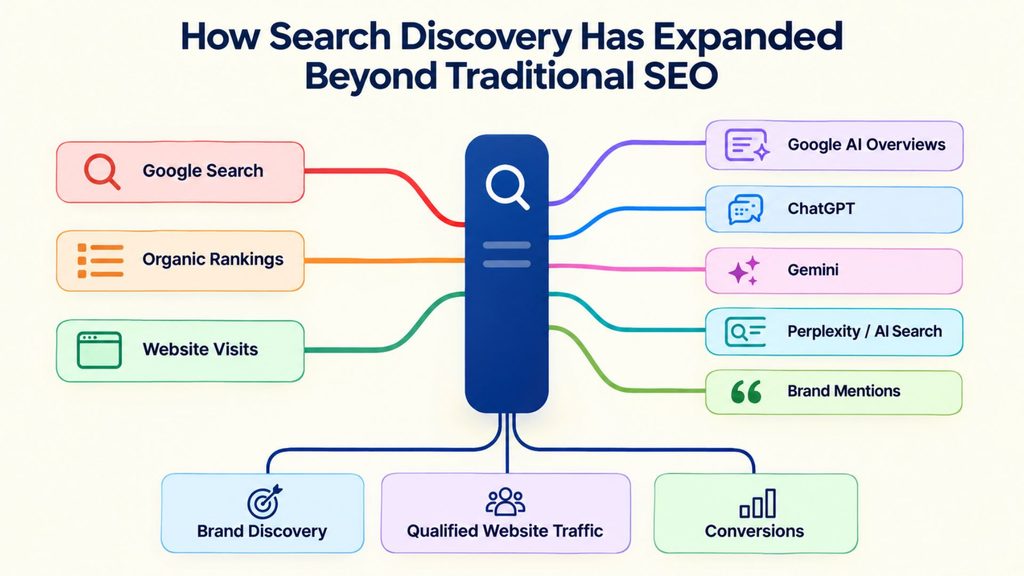
SEO reporting has traditionally focused on rankings, clicks, organic traffic, and leads. Those metrics still matter, but they no longer show the complete search journey.
People now discover brands through Google AI Overviews, AI Mode, ChatGPT, Gemini, Perplexity, traditional search results, and other AI-powered search experiences that may answer a question before a website visit happens.
For marketers, the goal is not to replace familiar SEO KPIs. It is to understand what happens before, during, and after the click. A brand can gain meaningful search visibility even when that exposure does not immediately generate an organic visit.
Do Rankings and Clicks Still Matter in 2026?
Yes. Keyword rankings, impressions, clicks, CTR, organic traffic, and conversions remain fundamental SEO performance metrics.
Rankings indicate whether important pages are visible for relevant searches. Impressions measure how often those pages appear. CTR helps show whether search listings attract attention, while clicks reveal actual traffic acquisition. Conversions then connect organic visibility with leads, enquiries, sales, or other business outcomes.
Google’s own guidance confirms that established SEO best practices continue to apply to AI Overviews and AI Mode. There are no separate technical requirements, or special AI-specific markup needed simply to become eligible for these features.
So, the issue is not that traditional SEO KPIs are obsolete. The problem is relying on them alone.
AI search measurement should extend the SEO reporting framework, not replace the metrics that already connect search performance with business results.
Why Traditional SEO Reporting Is No Longer Enough
Search journeys are no longer as straightforward as they once were.
A user may discover a brand through a Google AI Overview, ChatGPT, Gemini, or another AI-powered search experience without visiting the website immediately. They might encounter the brand again later, search for it by name, visit the website directly, and convert at a different stage of the journey.
This makes attribution more complex. The first interaction may contribute to awareness or brand discovery even when it does not generate the final click.
Google’s Generative AI performance reporting in Search Console also reflects this shift by giving eligible properties greater visibility into impressions generated through AI Overviews and AI Mode.
For SEO teams, this means reporting should look beyond traffic alone. Traditional metrics such as clicks, rankings, and conversions still matter, but they should be reviewed alongside broader indicators of search visibility, brand discovery, and AI-driven exposure.
The SEO KPIs That Still Matter
Traditional SEO metrics remain the foundation of any useful performance report.
| Traditional KPI | What It Tells You |
| Keyword Rankings | Where pages appear for relevant queries |
| Search Impressions | How often the website appears in Search |
| Organic Clicks | Traffic generated through organic search |
| CTR | How effectively search listings attract clicks |
| Organic Sessions | Website visits generated by organic channels |
| Leads / Conversions | Business outcomes influenced by SEO |
| Conversion Rate | How effectively organic traffic converts |
The key change is how these metrics are prioritized.
Consider two pages:
Page A
- 10,000 organic visits
- 20 leads
Page B
- 3,000 organic visits
- 45 leads
Page A generates more than three times the traffic, yet Page B produces more than twice the leads. If reporting focuses only on traffic growth, Page A may appear to be the stronger SEO asset.
Business-focused SEO reporting should instead ask which visibility and traffic actually contribute to meaningful outcomes. This is also where conversion rate optimization becomes relevant: attracting visitors has limited business value if those users do not take meaningful actions.
That same principle becomes even more important when adding AI search KPIs.
The New AI Search KPIs to Track in 2026
1. AI Search Impressions
For properties with access to Google’s Generative AI performance report, marketers can measure how frequently links from their site appear within supported generative Search experiences.
The current report covers AI Overviews and AI Mode and lets users analyze impressions over time and by dimensions including page, device, and country. Google is still rolling out the report, so it is not available to every Search Console property.
AI impressions provide a useful visibility metric, but they should be evaluated alongside traditional Search impressions, traffic, and conversions.
2. AI Citations
An AI citation occurs when an AI-generated answer references or links to a website as a source.
Relevant surfaces can include Google AI Overviews, AI Mode, ChatGPT Search, Gemini, and Perplexity.
Citation tracking can reveal whether a brand’s content is being selected as supporting information for questions related to its expertise.
However, not every platform offers a complete first-party citation report. Measurement may therefore require specialist AI visibility platforms, controlled prompt tracking, consistent query sets, and manual validation.
The goal is not simply to count citations. It is to determine whether the brand appears for commercially and topically relevant questions.
3. Brand Mentions in AI Answers
A brand mention is different from a citation.
An AI response could mention or recommend a company without linking directly to its website.
For example:
“Which SEO agencies specialize in AI search optimization in Dubai?”
Tracking responses to this type of query can show whether AI systems associate a brand with the service categories it wants to own.
Monitor whether AI answers:
- Mention the company
- Recommend it
- Associate it with relevant services
- Include it in competitor comparisons
A mention does not prove that a conversion will follow, but it can indicate brand discovery and topical visibility.
4. Entity Associations
Modern SEO measurement should also examine what a brand is associated with, not just how many times it appears.
For Gateway Marketing Digital, this means assessing whether search and AI platforms consistently connect the business with SEO, Dubai, performance marketing, generative engine optimization (GEO), answer engine optimization (AEO), and AI search optimization.
This represents an entity-association framework.
Marketers should assess whether search engines and AI systems consistently understand:
- Who the company is
- What services it provides
- Where it operates
- Which topics it has expertise in
Strong entity associations can improve machine understanding, but they should not be treated as a guarantee of rankings, citations, or AI recommendations.
5. Share of AI Answers
“Share of AI answers” can be used as an internal visibility metric similar to share of voice.
A simple calculation is to divide the number of relevant AI answers containing the brand by the total number of answers checked, then convert that figure into a percentage.
If Gateway Marketing Digital appears in 18 out of 100 consistently tracked responses, its AI visibility share for that specific query set would be 18%.
This is not an official Google metric.
It becomes useful only when methodology stays consistent. Use the same query set, platforms, geography, language, and testing process when comparing one reporting period with another.
Otherwise, the percentage can change simply because the measurement method changes.
6. AI Referral Traffic
Visibility is useful, but marketers should also measure when AI platforms actually send visitors to the website.
Google Analytics introduced an AI Assistant channel in May 2026. Recognized traffic from AI assistants such as ChatGPT, Gemini, and Claude can be classified separately through the AI Assistant default channel grouping.
Track:
- Sessions
- Engagement
- Leads
- Conversion rate
- Revenue
AI referral traffic should be separated from broader AI visibility. A brand may appear frequently in AI answers while receiving relatively few direct clicks.
7. Branded Search Growth and Assisted Conversions
Not every AI interaction produces an immediate referral.
Someone may see a business mentioned in an AI answer and later search for the brand name or combine the brand with a specific service.
Useful supporting metrics include:
- Branded search impressions
- Brand-plus-service queries
- Direct traffic trends
- Returning users
- Assisted conversions
- Multi-touch conversion journeys
These signals should be treated carefully. An increase in branded search after stronger AI visibility does not automatically prove that AI caused the increase.
Use attribution data and consistent trend analysis before drawing that conclusion.
How to Measure SEO and AI Search Performance
Google Search Console
Search Console remains the primary source for understanding organic Google Search performance.
Track:
- Queries
- Impressions
- Clicks
- CTR
- Average position
- Landing pages
- Generative AI impressions where available
Google’s dedicated Generative AI performance report currently focuses on impression visibility from AI Overviews and AI Mode and is being rolled out to a subset of properties.
Traditional and generative visibility should therefore be reviewed together rather than treated as two unrelated SEO programs.
Google Analytics 4
GA4 helps connect search visibility with onsite behavior and business outcomes.
Track:
- Organic sessions
- AI Assistant traffic
- Engagement
- Leads
- Conversion rate
- Revenue
- Multi-channel journeys
Search Console explains how users encounter the site in Google Search. GA4 helps explain what users do after arriving.
Used together, they provide a much stronger SEO measurement model.
AI Visibility Monitoring
Search Console and GA4 cannot provide complete cross-platform AI visibility.
Specialist tools or controlled manual monitoring can help track:
- AI citations
- Brand mentions
- Competitor appearances
- Prompt-level visibility
- Entity associations
- Share of AI answers
Use a fixed and representative set of queries. Randomly testing different prompts every month makes trend comparisons unreliable.
Build a Modern SEO KPI Dashboard
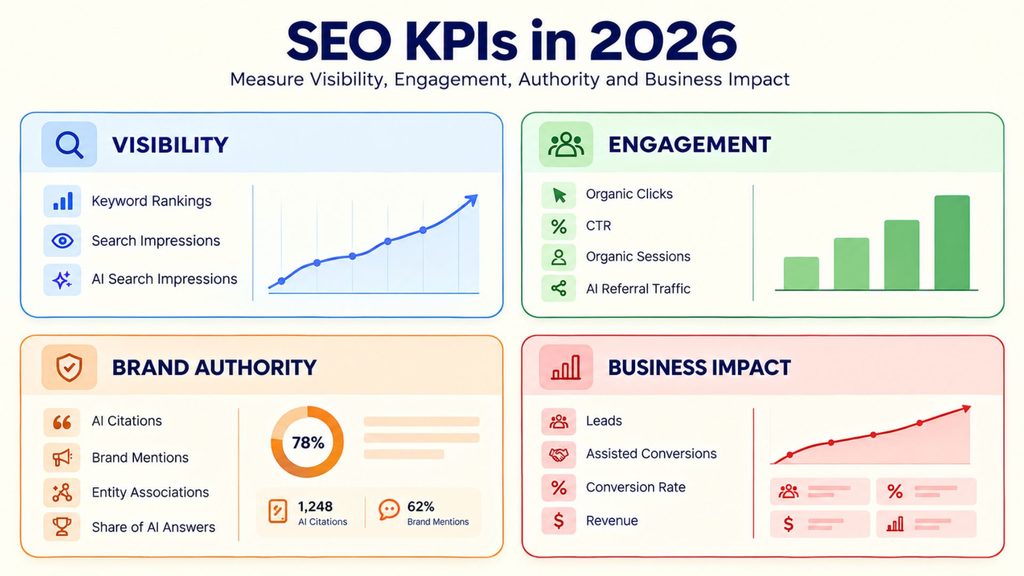
A practical SEO dashboard in 2026 can organize metrics into four layers.
| Layer | KPIs |
| Visibility | Rankings, search impressions, AI impressions |
| Engagement | Clicks, CTR, sessions, AI referral traffic |
| Brand Authority | AI mentions, citations, entity associations, share of AI answers |
| Business Impact | Leads, assisted conversions, revenue, conversion rate |
A useful dashboard should connect these four layers rather than treating them as isolated reporting categories.
Visibility shows whether the brand is being discovered. Engagement shows whether visibility generates meaningful interaction. Brand authority provides context around how the business is understood and referenced, while business-impact metrics determine whether the activity contributes to leads, conversions, and revenue.
This model prevents teams from stopping at vanity metrics. Ultimately, SEO performance should connect back to measurable business impact.
Final Takeaway
SEO measurement in 2026 needs to move beyond rankings and clicks without abandoning them. Rankings, search visibility, AI citations, brand mentions, referral traffic, conversions, and revenue each reveal a different part of the search journey.
The strongest reporting model connects those signals instead of viewing them separately. Gateway Marketing Digital can help businesses combine traditional SEO performance with emerging AI-search visibility and turn that data into a measurable search strategy.