Opens in a new tab

How Performance Marketing Services Generate High-Quality Leads and Sales for Businesses 

What You Will Learn

Many businesses generate website traffic and enquiries but still struggle to convert them into paying customers. In fact, the average conversion rate across e-commerce websites is below 2%, showing that attracting visitors alone does not guarantee sales. 

The real challenge is reaching people with genuine buying intent and guiding them towards the right action. Performance Marketing Services address this by connecting every campaign to measurable outcomes such as qualified leads, bookings, purchases and revenue. 

Through precise targeting, relevant advertising, conversion-focused landing pages and continuous optimisation, performance marketing helps businesses reduce wasted spending, improve customer acquisition and turn more marketing activity into meaningful growth. 

Why High-Quality Leads Matter More Than High Traffic 

Traffic shows how many people visit a website, but it does not indicate how many are likely to buy. A qualified lead is someone who matches the target customer profile, has a relevant need and is more likely to become a customer. 

High traffic can still produce poor results when visitors are outside the service area, lack the required budget or have little buying intent. Similarly, a low cost per lead is not valuable when those leads rarely convert. 

Businesses should therefore track: 

  • Qualified lead rate  
  • Lead-to-customer conversion rate  
  • Customer acquisition cost  
  • Revenue generated per campaign  
  • Customer lifetime value  

The objective is not to generate the highest number of enquiries, but to attract the right prospects and convert more of them into paying customers. 

How Performance Marketing Generates High-Quality Leads 

High-quality leads do not come from showing more ads to more people. They come from reaching the right audience with the right message, then making it easy for them to take the next step. 

Performance marketing brings targeting, messaging, landing pages and tracking together so every campaign can be judged by what it actually delivers: qualified enquiries, bookings, purchases and sales. 

1. Targeting People Based on Their Buying Intent 
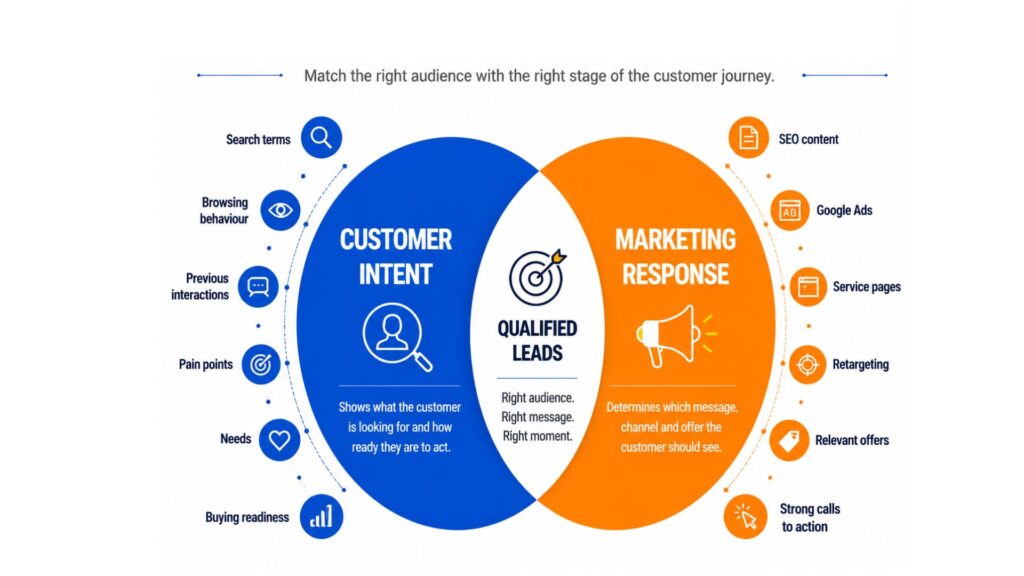
Not every search carries the same level of interest. 

Someone searching for “home interior design ideas” may be exploring options. Someone searching for “office fit-out company in Dubai” is far closer to requesting a quotation. 

Performance marketing uses search terms, browsing behaviour and previous interactions to identify this difference. Google Ads can reach people actively looking for a solution, while SEO can support users who are still comparing options. 

A strong performance marketing strategy creates content for both stages. Informational pages build trust, while service pages and search campaigns capture users with stronger buying intent. 

2. Reaching the Right Audience 

Better targeting means fewer wasted clicks and more relevant enquiries. 

Depending on the platform, campaigns can be refined by: 

  • Location  
  • Demographics  
  • Interests  
  • Search behaviour  
  • Website activity  
  • Customer lists  
  • First-party CRM data  

For example, a local clinic can focus on people within a practical service radius. A real estate company can promote specific properties to users interested in selected locations. A B2B company can target particular industries, company types or decision-makers. As campaign data builds, low-performing audiences can be excluded and stronger segments can receive more budget. 

3. Matching Ads With Real Customer Needs 

People are more likely to respond when an ad clearly reflects what they are looking for. 

A user searching for a specific treatment, training course or business service should see a message related to that exact need. Generic advertising may attract attention, but it often produces weaker enquiries. 

The call to action should also match the customer’s level of readiness. It may encourage them to: 

  • Request a quotation  
  • Book an appointment  
  • Schedule a consultation  
  • Register for a demo  
  • Download a guide  
  • View available properties  

Clear messaging helps users understand the offer before they enquire, improving both relevance and lead quality. 

4. Turning Clicks Into Enquiries With Better Landing Pages 

A good ad can still fail if it sends users to a confusing homepage. 

Dedicated landing pages keep the journey focused. They should explain the offer clearly, match the advertisement and guide visitors towards one main action. 

Key elements include: 

  • A clear value proposition  
  • Relevant information  
  • Strong trust signals  
  • Simple contact options  
  • A short, useful form  
  • A visible call to action  
  • Mobile-friendly design  
  • Fast page performance  

Lead forms can also improve qualification. A real estate form may ask about budget and preferred location, while a B2B form may ask about company size or project requirements. 

Through conversion rate optimization, businesses can test headlines, forms, layouts and offers to see what generates better enquiries. 

5. Tracking What Happens After the Click 

Clicks and form submissions only show part of the story. 

Businesses should track actions that indicate real value, such as: 

  • Phone calls  
  • WhatsApp enquiries  
  • Appointment bookings  
  • Demo requests  
  • Purchases  
  • Qualified leads  
  • Closed sales  

Conversion tracking shows which campaign produced an enquiry. CRM integration shows whether that enquiry became a customer. 

This matters because a campaign with fewer leads may still be more profitable if those leads convert at a higher rate. Performance should therefore be judged by lead quality and revenue, not volume alone. 

6. Improving Results Through Continuous Testing 

Performance marketing is built around ongoing improvement. 

Businesses can test: 

  • Keywords  
  • Audience segments  
  • Ad creatives  
  • Offers  
  • Landing pages  
  • Calls to action  
  • Lead forms  
  • Bidding strategies  

Weak elements can be reduced or removed, while successful campaigns receive more investment. 

This cycle helps improve customer acquisition, control wasted spend and keep campaigns aligned with changing customer behaviour, competition and advertising costs. 

How Different Businesses Benefit from Performance Marketing 

The principles of performance marketing remain consistent, but the channels, messaging and conversion goals should reflect each industry. 

Real Estate 

Real estate businesses often receive many enquiries, but not every enquiry comes from a serious buyer or tenant. 

Performance marketing can improve lead quality through location-based search campaigns, property-specific landing pages, retargeting and CRM tracking. 

For example, a company promoting apartments in Dubai Marina can target users searching for that specific property type and location. Instead of directing them to a general property website, it can send them to a page featuring relevant units, prices, amenities and viewing options. 

Forms can ask about budget, preferred area, property type and expected buying timeline. This information helps agents prioritise more suitable enquiries and spend less time following up with poorly matched prospects. 

Healthcare and Medical Businesses 

Clinics, dental practices, diagnostic centres and other healthcare providers can use performance marketing to connect with people actively seeking a particular service. 

A dental clinic might create Google Ads campaigns for specific treatments in nearby areas. A diagnostic centre may build individual landing pages for different tests. A medical practice may track calls, online forms and appointment bookings. 

Local SEO can also improve visibility when people search for healthcare services near them. 

The objective is not simply to increase website traffic. It is to make relevant information easy to find and provide a clear route to an appointment. 

Healthcare advertising should remain accurate, responsible and compliant with applicable regulations and platform policies. Campaigns should not use exaggerated promises or guaranteed treatment outcomes. 

E-commerce Businesses 

For e-commerce brands, website traffic only matters when it contributes to purchases. 

Performance marketing can use Google Shopping, paid social campaigns, product remarketing and abandoned-cart activity to bring users back to products they have already viewed. 

Campaigns can be evaluated using: 

  • Purchases  
  • Revenue  
  • Average order value  
  • Cost per acquisition  
  • Return on ad spend  

Conversion optimisation can also improve product pages, checkout steps, delivery information, trust elements and mobile usability. 

This helps the business identify which products, audiences and advertising channels generate profitable sales rather than simply attracting visitors. 

Education and Training Providers 

Education providers need enquiries from students who are interested in the right course, schedule, location and fee level. 

Course-specific campaigns can send users to focused pages containing curriculum details, entry requirements, fees and registration options. Providers can track brochure downloads, counselling calls, webinar registrations, applications and completed enrolments. 

CRM follow-ups can help nurture prospects who need additional information before making a decision. 

By connecting campaigns with enrolment data, institutions can understand which channels generate genuine students rather than only initial enquiries. 

Startups and B2B Businesses 

Performance marketing for startups helps teams test demand before committing large budgets. 

A startup can compare audience segments, messages and offers to determine what generates interest. It can measure demo requests, trial registrations, sales calls and customer acquisition cost. 

B2B businesses may combine search campaigns, LinkedIn advertising, educational content, landing pages and CRM tracking. Forms can include qualifying questions related to company size, industry, project requirements or expected timeline. 

Once the business identifies a reliable combination of audience, message and offer, it can scale based on evidence rather than assumptions. 

Common Mistakes That Reduce Lead Quality 

Even well-funded campaigns can generate poor results when common mistakes go unnoticed. Here are the most frequent issues that reduce lead quality: 

1. Targeting Too Broad an Audience 

Trying to reach everyone often attracts users who have little interest or buying intent. Narrowing your audience based on location, behaviour and demographics leads to more relevant enquiries. 

2. Optimising for Clicks Instead of Conversions 

A high click-through rate may look impressive, but it doesn’t guarantee sales. Focus on meaningful metrics such as qualified leads, bookings and revenue rather than clicks alone. 

3. Sending Traffic to Generic Landing Pages 

If your landing page doesn’t match the advertisement or search intent, visitors are less likely to convert. Dedicated landing pages create a more relevant and seamless customer journey. 

4. Not Qualifying Leads 

Forms that only ask for a name and email may generate more enquiries but provide little insight into whether the prospect is a good fit. Adding relevant qualification questions helps your sales team prioritise genuine opportunities. 

5. Incomplete Conversion Tracking 

Without tracking calls, form submissions, purchases and CRM data, it’s impossible to know which campaigns are generating real business outcomes. 

6. Ignoring Sales Feedback 

Marketing teams should regularly review lead quality with sales teams. This helps identify which campaigns attract genuine prospects and which generate low-value enquiries. 

7. Scaling Campaigns Too Early 

Increasing budgets before validating targeting, messaging and landing pages often amplifies inefficiencies. Optimise first, then scale campaigns that consistently generate qualified leads and sales. 

When Should a Business Work with a Performance Marketing Agency? 
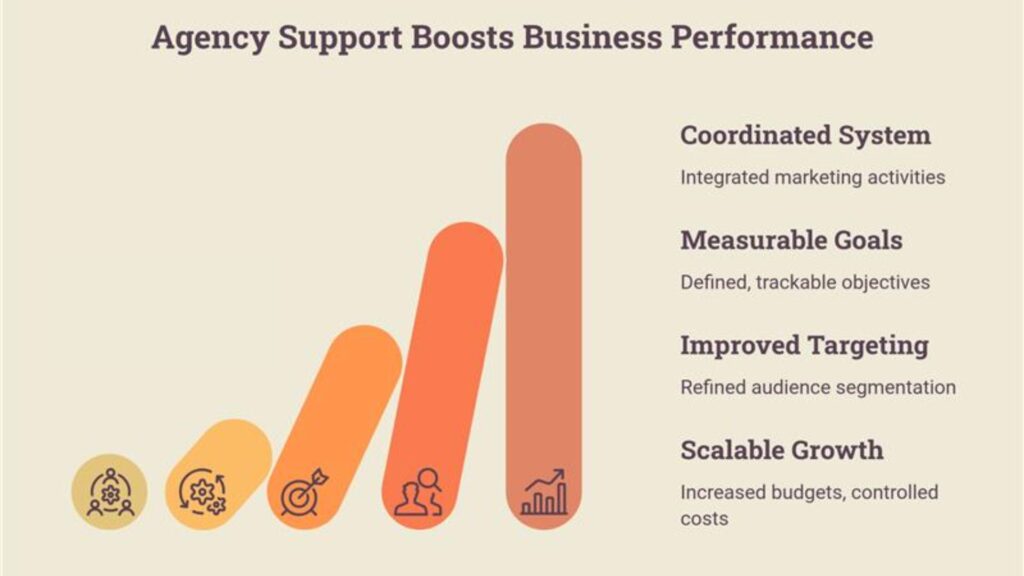
Performance Marketing Agency Boosts Business Performance

A business may need specialist support when marketing activity is increasing but leads and sales remain inconsistent. 

Common warning signs include rising advertising costs, poor-quality enquiries, incomplete tracking and reports that focus on clicks rather than revenue. Internal teams may also lack the time or expertise to manage paid advertising, analytics, landing pages and conversion optimisation together. 

A Performance Marketing Agency can help create a coordinated system across these areas. This may involve defining measurable goals, setting up conversion tracking, refining targeting, improving landing pages and reviewing lead quality with the sales team. 

Agency support can also be useful when a business is preparing to scale. Increasing budgets requires an understanding of which channels, audiences and offers can grow without causing acquisition costs to rise sharply. 

The right agency should be transparent about performance and connect its recommendations to qualified leads, customer acquisition and sales, not simply impressions or reach. 

Final Words 

When customer intent, targeting, advertising, landing pages, tracking and sales feedback work together, businesses gain a clearer understanding of where their customers come from and which marketing activities create value. 

This is particularly important for startups and growing businesses that need to control acquisition costs and scale with confidence. 

Need more qualified leads, not just more clicks? Contact Gateway Marketing Digital helps businesses and startups develop performance marketing strategies focused on better lead quality, measurable growth and increased sales. 

Frequently Asked Question

The required budget depends on the industry, target location, competition, campaign goals and chosen channels. Businesses should begin with a realistic test budget that can generate enough data for meaningful optimisation, rather than spreading a very small budget across too many platforms. 

There is no single best channel for every business. Google Ads is often effective for capturing existing demand, while Meta Ads can help create demand and reach specific audiences. SEO, retargeting and landing-page optimisation may also support the customer journey. The right mix depends on where potential customers search and make decisions. 

Success should be measured using business-focused metrics such as qualified leads, cost per qualified lead, conversion rate, customer acquisition cost, return on ad spend and revenue. Clicks and impressions can provide context, but they should not be treated as the final result.

Yes. For B2B companies, real estate firms and other businesses with longer decision-making processes, performance marketing can track early actions such as consultation requests, brochure downloads and demo bookings. CRM data and lead nurturing are then used to connect those actions with later sales. 

Starting with the channel that best matches customer intent is usually more effective than launching everywhere at once. Once the business identifies a reliable source of qualified leads, it can add complementary channels such as retargeting, paid social, SEO or email nurturing. 

A performance marketing agency typically needs clear business goals, target locations, ideal customer profiles, service or product details, pricing, previous campaign data and access to analytics or CRM systems. Sales-team feedback is also valuable for defining what qualifies as a strong lead. 

No responsible agency can guarantee a fixed number of leads or sales because results are influenced by competition, demand, pricing, the offer, sales follow-up and market conditions. Performance marketing improves decision-making through testing, measurement and optimisation, but it should not be presented as a guaranteed outcome. 

Read Next

Two people reviewing lead generation cost figures on paper beside laptops

Lead Generation Cost in Dubai: What Actually Drives It

Lead generation cost in Dubai is set by four things: the channel, the offer, how hard the form qualifies people, and how fast your team follows up. The same budget can produce leads at AED 53 or at AED 280 depending on those four choices. What matters is not the cheapest lead but the cost of a lead that turns into a viewing, a booking or a sale.

Gateway Marketing Digital has run lead generation for UAE businesses since 1997. Below we break down what pushes the cost per lead up or down in Dubai, with real figures from campaigns we have published as case studies, and how to judge whether a quote you have been given makes sense.

What decides lead generation cost in Dubai?

There are two costs to look at. The first is media cost: what Meta or Google charges you to reach people and get them to raise their hand. The second is the cost of the system around the ads: landing pages, creative, tracking, the lead sheet or CRM, and the people who call leads back. A low media cost with a weak system still produces expensive customers, because most of the leads go nowhere.

So the useful number is cost per qualified lead, and after that cost per sale. Any lead generation cost in Dubai should be read next to those two figures.

1. Which channel brings the lead in?

Meta ads (Facebook and Instagram) create demand: you reach people before they search, so leads are usually cheaper but colder. Google Search captures people already looking, so clicks cost more but intent is higher. WhatsApp sits on top of both, and in the UAE it often decides quality.

On the Dubai Jewel Tower launch for Rocky Real Estate, 44% of WhatsApp leads qualified, against 11% of Meta lead form leads. The form leads were cheaper to buy. The WhatsApp leads were far cheaper per qualified buyer.

2. How valuable and how clear is the offer?

A specific offer with one clear next step costs less per lead than a general brand message. A free masterclass, a property brochure or a consultation gives people a reason to act now. For coaching brand Anita Milovac, a masterclass funnel we built brought in 372 leads at AED 6.58 each, about a third below the target set before launch, because the offer itself was the first taste of the coaching.

High-value purchases cost more per lead, and that is fine. A Dubai property buyer or a three-month meal plan subscriber is worth thousands of dirhams, so the business can afford to pay more for each serious enquiry.

3. How much does the form qualify people?

Every question you add to a form raises the cost per lead and lowers the number of leads. It also removes time wasters. For Simply Healthy Diets, the landing page form asked for the plan wanted, days per week and the main goal before contact details. The campaign produced 164 qualified enquiries in five months, and at least 6.7% became clients worth AED 7,000 to 8,000 each.

The rule we use: qualify harder when your sales team is small or your product is expensive, and qualify lightly when volume matters and follow-up is automated.

4. What is the campaign told to optimise for?

Meta and Google find more of whatever you tell them counts as a result. If that is a form fill, they find form fillers. If your real outcomes (qualified, viewed, booked, paid) are sent back to the platforms, they learn to find buyers. Google calls this offline conversion import, and Meta has the Conversions API for the same job.

When the Dubai Jewel Tower campaigns were judged on qualified rate instead of raw volume, cost per lead fell 41% within a month, from AED 176 to AED 103, while the qualified rate rose from 22.4% to 31.8%. In the second phase the campaigns delivered about 944 leads at about AED 53 each, around 81% below the approved target of AED 280.

5. How fast does someone call the lead back?

Follow-up speed does not change the price you pay Meta for a lead. It changes how many of those leads you keep. A lead called within the first hour is far more likely to book than one called the next day, so slow follow-up quietly doubles your real cost per sale. Instant alerts to the sales team and a lead sheet that tracks every contact attempt are part of the cost, not an extra.

6. How competitive is your market in the UAE?

Dubai real estate, finance and premium services compete with many advertisers for the same audiences, especially in peak seasons, so media costs rise. Niche B2B offers often have fewer competitors in the auction but smaller audiences. Seasonality matters too: Ramadan, summer and year-end all shift costs in the UAE, which is why campaigns are planned a quarter ahead.

How do lead generation companies charge?

You will see three models in Dubai. Each one moves the risk to a different side of the table.

  • Monthly management fee plus ad spend: you own the ad accounts and pay the platforms directly. Most transparent, and you keep all the data.
  • Pay per lead: predictable on paper, but the provider is rewarded for volume, so define a qualified lead in writing first.
  • Performance or commission: the provider is paid on sales. Fair when sales tracking is reliable, risky when it is not.

Whichever model you pick, ask who owns the leads, the ad accounts and the pixel. We cover that in more detail on our lead generation agency in Dubai page.

How to judge a lead generation cost in Dubai before you spend

  1. Work out what a customer is worth to you over the first year.
  2. Estimate your close rate from a qualified lead (your sales history is the best guide).
  3. Divide the acquisition cost you can afford by the leads needed per sale. That is your ceiling cost per qualified lead.
  4. Compare any quote or target against that ceiling, not against what another business pays.

For high-value buyers, the maths usually allows a higher cost per lead than people expect. Our post on high-ticket lead generation in the UAE walks through that side.

FAQ: lead generation cost in Dubai

What is a good cost per lead in Dubai?

It depends on what a customer is worth. Across our published campaigns, cost per lead ranged from AED 6.58 for a coaching masterclass to about AED 53 to AED 149 for Dubai property. Judge it against your qualified rate and close rate, not against another industry.

Are cheap leads a bad sign?

Not always, but check them. Cheap lead form leads often qualify at a lower rate: on one Dubai property launch, 11% of form leads qualified against 44% of WhatsApp leads. Look at the cost per qualified lead before you celebrate a low cost per lead.

How long before the cost per lead settles?

Expect the first two to four weeks to be the most expensive while the platforms learn. On the Dubai Jewel Tower launch, cost per lead fell 41% within the first month once budget moved to the channels producing qualified buyers.

Should I pay per lead or pay a monthly fee?

A monthly fee with ad accounts in your name keeps the data and the learning with you. Pay per lead can work for simple offers, but only with a written definition of a qualified lead and the right to reject leads that do not meet it.

Next step

The right lead generation cost in Dubai is the one your sales maths can carry, measured on qualified leads and sales. If you want us to look at your current cost per lead and where it leaks, contact our team.

Read More
PPC Landing Page Checklist

High-Converting Landing Page Checklist for PPC Campaigns 

You can have the right keywords, persuasive ad copy and a strong click-through rate and still watch your PPC budget disappear without enough enquiries. 

People are clicking, but something breaks after they reach the website. The message feels different; the form asks too much, or the next step is unclear. 

A high-converting landing page closes that gap. This PPC landing page checklist reviews the complete experience, from message matching and copy to mobile usability, tracking and lead quality.  

What Is a PPC Landing Page? 

A PPC landing page is created for visitors arriving through Google Search Ads, Meta Ads, LinkedIn Ads, display campaigns or remarketing. 

Unlike a homepage, it is not meant to introduce every service. Its job is more focused: speak to one audience, present one offer, and encourage one primary action. 

Homepage  PPC Landing Page 
Presents multiple services  Promotes one campaign-specific offer 
Serves a broad audience  Targets a defined audience 
Uses several CTAs  Prioritizes one conversion goal 
Shares general information  Continues the ad’s message 
Supports exploration  Focuses on conversion 

Why PPC Landing Pages Fail to Convert 

Most landing pages fail because of several small points of friction. The headline does not match the ad, the offer is buried, the form feels like an application, or the mobile experience is frustrating. 

These may seem minor to the business, but they create enough doubt to make a visitor leave. 

High-Converting PPC Landing Page Checklist 

1. Make Sure the Page Keeps the Ad’s Promise 

Imagine clicking an ad for a free PPC audit and landing on a general digital marketing homepage. You would probably wonder whether you clicked the wrong link. 

Your visitors react the same way. Keep the service, offer, audience and expected outcome consistent from ad to landing page. Strong message matches reassure visitors and support better Google Ads campaign performance.  

2. Replace Generic Headlines with a Clear Benefit 

“Grow Your Business with Us” sounds positive but says very little. 

A stronger headline identifies the problem and the offer: “Reduce Your Google Ads Cost per Lead with a PPC Campaign Audit.” 

PPC Landing Page

Do not make visitors decode clever wording. Tell them what is available and why it matters. 

3. Make the Value Clear Before Visitors Scroll 

The first screen should answer: “Why should I continue?” 

Include a specific headline, a short supporting line, one key benefit, a relevant visual, a prominent CTA, and an immediate trust signal. Avoid long paragraphs and competing buttons. 

4. Give the Page One Main Job 

Asking visitors to book a call, download a guide, explore services and follow social profiles creates decision fatigue. 

Choose one primary goal and repeat that CTA where needed. A focused goal also makes it easier to track campaign performance and understand which actions are driving meaningful results.  

5. Write a CTA That Explains the Next Step 

“Submit” does not tell visitors what they will receive. 

Use specific wording such as: 

  • Request a Free PPC Audit 
  • Book Your Strategy Call 
  • Get a Custom Proposal 
  • Speak With a PPC Specialist 

On longer pages, repeat the CTA after important sections. 

6. Do Not Turn the Lead Form into Homework 

A prospect may be ready to enquire, then change their mind when they see fifteen required fields. 

Ask only for information needed to respond to or qualify for the lead. Fewer fields may increase submissions, while selected questions about budget, location, or timeline may improve quality. Aim for the least friction needed to collect a useful enquiry. 

7. Translate Features into Outcomes 

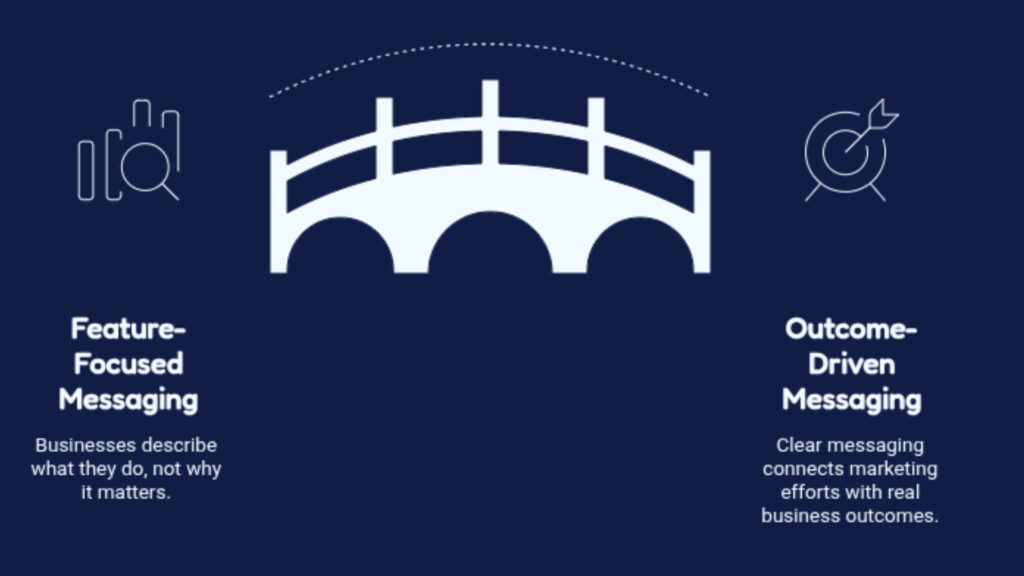
Businesses often describe what they do without explaining why it matters. 

Advanced conversion tracking

Feature: Advanced conversion tracking 

Benefit: Identify which ads, keywords, and campaigns generate qualified leads and revenue. 

Review each claim and ask, “What does this help the customer achieve?” This approach helps create clearer messaging that connects marketing efforts with real business outcomes.  

8. Give Visitors a Reason to Trust You 

Paid visitors may have never heard of your company. 

Use genuine testimonials, verifiable case-study results, client logos, reviews, certifications, and clear privacy information. Avoid fabricated reviews or inflated claims. Trust comes from specific, believable proof. 

9. Remove Anything That Competes with the Conversion 

Full navigation, unrelated links, social icons, and pop-ups can pull visitors away from the intended journey. 

Consider simplifying them while retaining essential footer links such as the privacy policy, terms and contact details. The aim is not to trap visitors; it is to make the promised next step easier to find. 

10. Design for the Person Holding a Phone 

A page may look polished on a laptop and still frustrating on mobile. 

Check readable font sizes, thumb-friendly buttons, short forms, click-to-call and WhatsApp links, proper image scaling, comfortable spacing and fast loading. Test the entire journey on real devices. 

11. Do Not Let a Slow Page Waste Paid Clicks 

Every paid click has a cost. When visitors leave before the main content loads, that spend produces no opportunity. 

Review oversized images, unused scripts, third-party tags, heavy videos, server response time, and layout shifts. Page Speed Insights and Lighthouse can identify issues, but prioritize a fast, stable experience over a perfect score. 

12. Use Visuals That Help Visitors Decide 

A generic stock photo may fill out space, but it rarely helps someone understand the offer. 

Use product screenshots, dashboard previews, process diagrams, genuine team photos, comparison graphics, or case-study charts. Each visual should explain, demonstrate, or reassure. Compress images properly so they do not slow the page. 

13. Answer the Questions Visitors Hesitate to Ask 

Even interested prospects may worry about price, timelines, contracts, privacy, or implementation. 

Use concise FAQs, clear processes, and transparent information to reduce uncertainty. Do not hide every important detail behind a contact form. Honest clarity is often more persuasive than exaggerated promises. 

14. Track More Than Form Submissions 

A campaign cannot be improved when the business only knows that “someone filled out the form.” 

Track calls, WhatsApp clicks, bookings, purchases, demo requests and thank-you page visits. Connect Google Ads, GA4, Tag Manager and CRM data where appropriate. For successful lead generation, qualified opportunities matter more than simply increasing the number of submissions. 

15. Use the Thank-You Page to Continue the Experience 

The journey should not end with a blank “Form submitted” message. 

A useful thank-you page confirms the action, explains what happens next, and gives an expected response time. It may also offer a calendar link, download, or direct contact option while supporting clearer tracking. 

16. Test the Journey Before Paying for Traffic 

Complete the full process as if you were the customer. 

Click on each CTA, submit the form, test validation messages, call buttons, WhatsApp links, email notifications, CRM entries and conversion tags. Repeat the process on desktop and mobile. A broken form can quietly waste campaign spending. 

17. Use A/B Testing to Settle Opinions 

Landing-page decisions often become debates based on personal preference. 

A/B testing replaces opinion with evidence. Test the headline, CTA, hero visual, form length, offer or testimonial placement. Where practical, test one major change at a time and wait for enough data. This approach helps businesses improve landing-page performance through continuous conversion rate optimization.  

18. Judge the Page by Lead Quality 

A higher conversion rate is not always a better business result. 

If most enquiries are irrelevant, the extra conversions have little value. Review qualified lead rate, cost per qualified lead, appointment rate, sales conversion rate, customer acquisition cost and revenue. Landing-page optimization should improve commercial outcomes, not just dashboard numbers. 

Quick PPC Landing Page Audit Table 

Use this landing page audit checklist before launch and whenever performance changes. 

Element  Question to Check 
Message match  Does the page continue with the promise made in the ad? 
Headline  Is the main benefit immediately clear? 
CTA  Is there one obvious primary action? 
Form  Does it ask only for necessary information? 
Trust  Is there genuine, relevant proof? 
Mobile  Can visitors convert easily on a phone? 
Speed  Does the page load quickly and remain stable? 
Tracking  Are leads, calls, and sales recorded accurately? 
Distractions  Are unnecessary links and pop-ups removed? 
Testing  Are decisions based on reliable data? 

How Often Should You Audit a PPC Landing Page? 

Audit the page before launching, after changing the ad or offer, and whenever cost per lead rises, conversion rate falls or lead quality declines. Recheck it after website, form or tracking updates. 

Monthly reviews can uncover technical problems, while quarterly reviews can address broader changes in audience behavior and strategy.  

Final Thoughts 

A PPC campaign fails with clicks alone; it succeeds when those clicks turn into valuable customer actions. 

Your landing page plays a crucial role in converting paid traffic into qualified leads. By improving clarity, trust, usability, and tracking, businesses can make better use of their advertising investment.  

If your PPC campaigns are generating traffic but not enough enquiries, Gateway Marketing Digital, a designrush verified PPC agency, can help optimize your campaigns, landing pages and conversion journeys to improve performance and ROI.   

Request a PPC landing page audit today and contact our team to identify opportunities to convert more visitors into customers.  

Read More
meta ads for real estate in Dubai

How Meta Ads Help Real Estate Businesses Generate Quality Leads in Dubai 

Meta ads for real estate in Dubai bring quality leads when every project has its own landing page, enquiries can come in by WhatsApp as well as by form, and agents call back fast. That is how our Meta ads and WhatsApp campaign for Dubai Jewel Tower, a new residential tower in Al Barsha, generated 1,122 leads in about three months, with 145 of them reaching the viewing stage.

Facebook and Instagram give developers, brokers and property consultants a visual way to present projects and reach potential buyers. But strong results depend on more than launching an ad. Audience strategy, creative quality, lead qualification, landing pages, tracking and fast follow-up all matter. This guide explains how these parts work together to attract better enquiries.

What Results Can Meta Ads for Real Estate in Dubai Deliver?

These are real numbers from our own property campaigns in Dubai, published in full in our case studies:

  • 1,122 leads in about three months for the Dubai Jewel Tower launch, with 145 taken to the viewing stage (Dubai Jewel Tower case study).
  • Cost per lead down 41% in the first month of optimisation, from AED 176 to AED 103, while the qualified rate rose from 22.4% to 31.8%.
  • 44% of WhatsApp leads qualified, against 11% of Meta lead form leads, so budget moved towards WhatsApp.
  • Brokers made up nearly a quarter of all leads once we ran a separate broker channel next to the buyer ads.
  • 219 property viewings at a 17% lead-to-viewing rate on ready stock, and 33% on The Bay in Business Bay, from our earlier Meta and Google campaigns for Rocky Real Estate (brokerage case study).

Why Do Meta Ads Work for Dubai Real Estate Businesses?

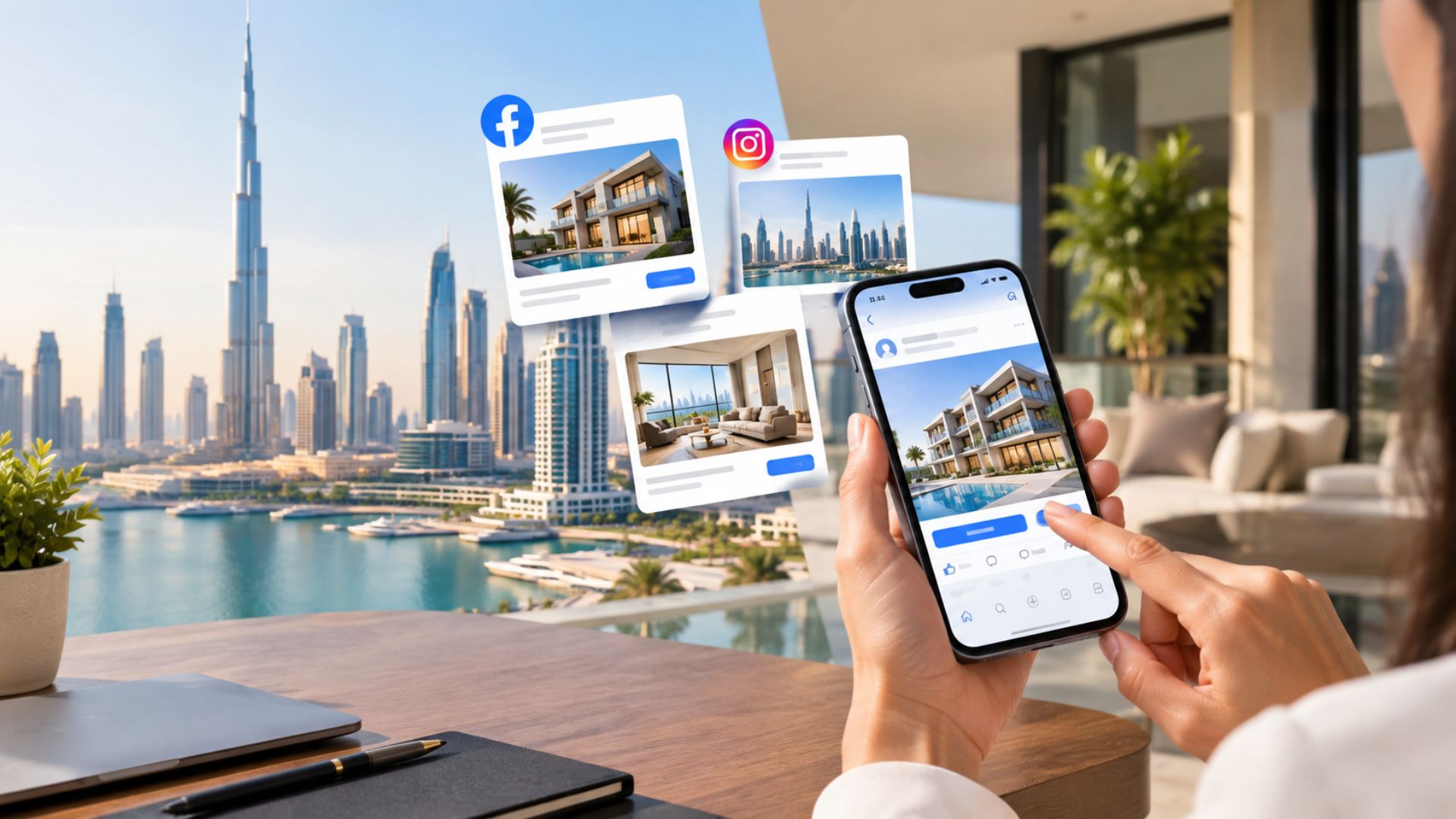
Real estate is highly visual, which makes Facebook and Instagram useful for property marketing. Buyers can quickly see a project’s design, views, location, amenities, floor plans and lifestyle through images, videos, carousels, Reels and Stories.

Meta campaigns can support apartments, villas, off-plan developments, rentals, luxury homes and commercial projects. They can also reach people in Dubai and selected international markets.

Targeting should not be treated as perfectly accurate. Meta treats housing ads as a Special Ad Category in many markets, and some audience options may be limited depending on the market and campaign setup. Read Meta’s guide to choosing a Special Ad Category and check the options currently available in Ads Manager before building a campaign.

How Do Meta Ads Generate Real Estate Leads?

Meta Ads for real estate lead generation

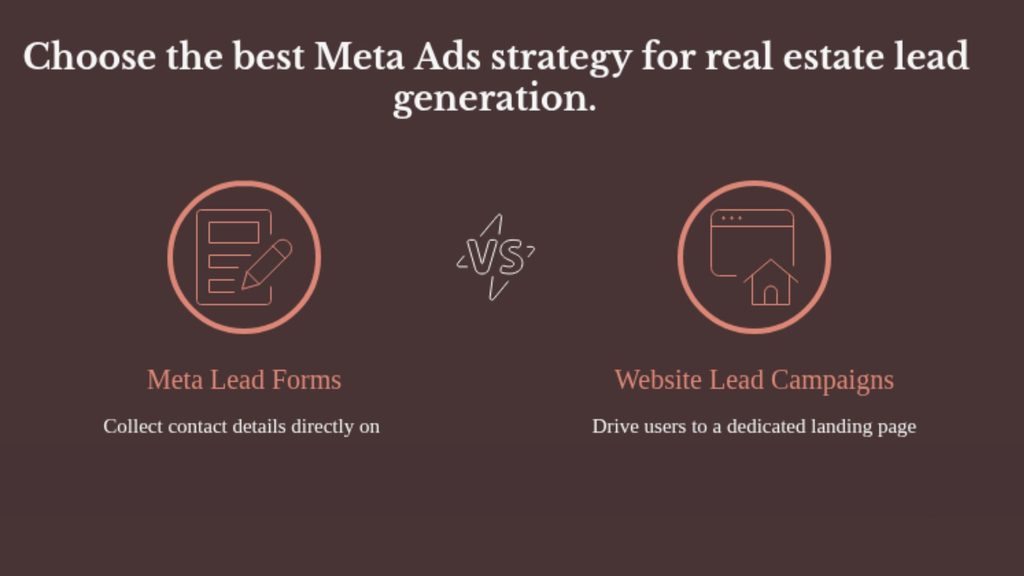
Meta Ads can generate enquiries in several ways. A campaign can collect contact details directly on Facebook or Instagram, send users to a dedicated property landing page, open a WhatsApp or Messenger conversation, or promote a specific development.

Strong campaigns usually match one clear offer with one clear next step. Someone seeing an off-plan project should quickly understand the location, property type, key benefit and what to do next.

Retargeting can also reconnect with people who showed interest but did not enquire the first time.

Meta Lead Forms

Meta lead forms let users submit information without leaving Facebook or Instagram. This can make it easier to request a brochure, availability details or a call from an advisor.

Forms should collect enough information to qualify the enquiry without becoming too long. Because they are so easy to fill in, they also attract more casual enquiries: on the Dubai Jewel Tower launch, lead form leads qualified at a quarter of the WhatsApp rate.

WhatsApp Conversations

Click-to-WhatsApp ads open a chat with the sales team. A buyer who starts a conversation is usually further along than one who taps a pre-filled form, which is why WhatsApp produced our highest qualified rate. It only works if every chat is answered quickly and logged against the ad that started it.

Website Lead Campaigns

A dedicated landing page is useful when buyers need more information before enquiring. It can show project details, images, location, amenities, floor plans, pricing and trust signals in one place.

How Do You Target the Right Real Estate Audience in Dubai?

Audience planning should start with the property, not with a long list of targeting settings.

Location Targeting

A Dubai-focused project may target people already in the UAE, while an investment campaign may also include selected markets such as the GCC, India or the UK.

The right locations depend on the property price, buyer profile, project type and sales strategy. A luxury investment project may need a different audience from a mid-market rental campaign.

Interest and Behaviour-Based Audiences

Signals related to property investment, luxury real estate, mortgages, relocation, investment or business may be useful where Meta makes them available. However, real estate advertisers should not assume every interest or behaviour can be used.

Housing advertising can have additional targeting restrictions, so available options should be checked inside the current campaign setup rather than copied from an old targeting list.

Custom and Lookalike Audiences

Website visitors, video viewers, existing leads, previous customers and people who engage with Facebook or Instagram can provide useful first-party signals.

Custom audience and lookalike availability may differ for housing campaigns, so advertisers should confirm what Meta currently allows for the relevant market.

Brokers as a Second Audience

For a new launch, brokers who bring their own buyers deserve their own ads, message and follow-up. On Dubai Jewel Tower, the broker channel brought in nearly a quarter of all leads, alongside the buyer campaigns.

Which Meta Ad Formats Work Best for Real Estate Marketing?

Meta ads formats for real estate marketing in Dubai

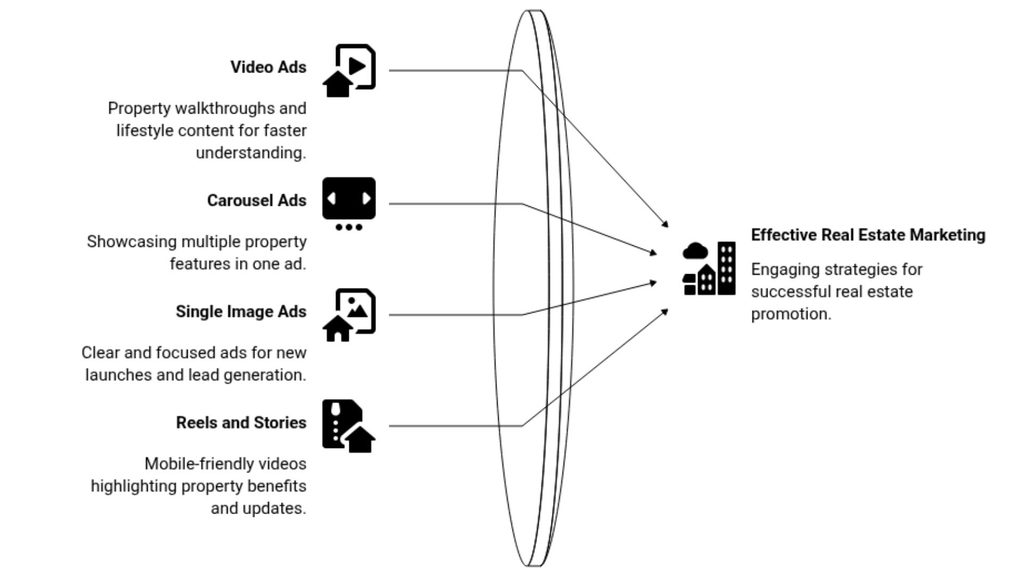
Video Ads

Video works well for property walkthroughs, project introductions, location highlights, construction updates and lifestyle content. It can help buyers understand a property faster than a long block of text.

Carousel Ads

Carousel ads can present several parts of one project. Each card can show a room, amenity, view, floor plan or unit type.

Single Image Ads

A strong single image works well for new launches, limited availability, open houses and simple lead generation campaigns. The message should stay clear and focused.

Reels and Stories

Reels and Stories are designed for mobile viewing. Short vertical videos can highlight a property feature, view, location benefit or project update.

What Makes a Real Estate Meta Ad Generate Better Leads?

A good property ad answers the questions a serious buyer is likely to have. It should clearly show what is being offered, where the property is located, what type of unit is available and why the person should take the next step.

Strong ads often include quality images or videos, a clear location, property type, unit size, major amenities and starting price where appropriate. The opening line should attract attention without making unrealistic claims.

The call to action should match the buyer’s stage. Useful options include “Book a Viewing”, “Request Property Details”, “Download the Brochure”, “Check Available Units” or “Speak with a Property Advisor”.

The experience after the click must also match the promise made in the ad.

How Can You Improve the Quality of Real Estate Leads?

Lead volume alone does not show whether a campaign is successful. A low-cost lead has little value if the person has the wrong budget, wants a different property type or has no realistic buying plan.

Businesses using Meta ads for real estate in Dubai should include simple qualification steps. A form can ask about budget range, preferred property type, buying timeline and whether the person is an investor or an end user. For premium projects, our guide to high-ticket lead generation in the UAE covers how to reach and qualify high-net-worth buyers.

Ad copy can also help filter enquiries by stating the location, starting price, unit type, payment plan or expected completion date where relevant.

Qualified leads should move quickly into a CRM or sales process. The sales team should know which campaign and project generated the enquiry and follow up while the buyer still remembers the property. On our brokerage campaigns, the sales team contacted 75% of ready-property leads, and moving budget to the projects that booked the most viewings is what lifted The Bay to a 33% lead-to-viewing rate.

How Does Retargeting Reach Interested Property Buyers Again?

Property decisions are rarely instant. A buyer may view several projects, compare prices, discuss financing or wait before contacting an agent.

Retargeting helps a business reconnect with people who already showed interest. This may include users who visited a property page, watched a video, engaged with Facebook or Instagram, clicked an ad, opened a form without submitting it or visited the website without enquiring.

The follow-up ad should add value rather than repeat the first message. It could highlight floor plans, availability, payment options, project progress or a new property video.

Why Do Your Landing Page and Tracking Matter?

Paid advertising cannot fix a weak website experience. A landing page should load quickly on mobile, explain the property clearly and make it easy to enquire.

Useful elements include project images, property details, location, amenities, pricing where appropriate, a short form, phone or WhatsApp options, and trust signals such as developer or project information.

Tracking is equally important. Meta Pixel records website actions from the browser, while Conversions API can send selected event data from a server or connected source. GA4 helps measure website behaviour, CRM tracking connects leads with later sales activity, and UTM parameters help identify which campaign generated a visit.

These tools make it easier to judge lead quality instead of relying only on ad platform numbers.

What Are the Common Meta Ads Mistakes in Real Estate?

One common mistake is building a campaign around broad assumptions instead of a clear buyer and property offer. Another is using the same creative for too long, even when people stop responding.

Businesses also waste budget when they send every ad to the homepage instead of a relevant project page. Weak mobile pages, unclear forms and slow loading can reduce enquiries after a user has clicked.

Focusing only on cheap cost per lead is another problem. A campaign with fewer qualified enquiries can be more valuable than one producing many low-intent leads.

Other common issues include poor qualification, slow sales follow-up, no retargeting, weak conversion tracking, and forms that ask for too little or too much information.

Which Metrics Should Real Estate Businesses Track?

Cost per lead is useful, but it should not be the only metric.

Businesses should also track qualified lead rate, cost per qualified lead, landing page conversion rate, viewing or appointment booking rate, sales conversion rate, and return on ad spend when revenue can be measured accurately.

For example, one campaign may generate cheaper leads, while another produces more viewings and buyers. The second campaign may therefore be more valuable.

Clicks, impressions and raw lead numbers show activity. On their own, they do not show whether advertising is creating useful sales opportunities.

FAQ: Meta Ads for Real Estate in Dubai

Do Meta ads work for real estate in Dubai?

Yes, when each project has its own landing page, enquiries can come in by WhatsApp as well as by form, and agents follow up fast. Our Meta ads and WhatsApp campaign for Dubai Jewel Tower generated 1,122 leads in about three months, and 145 of them reached the viewing stage.

What is a good cost per lead for real estate Meta ads in Dubai?

Judge cost per qualified lead and viewings, not raw cost per lead. In its second phase, the Dubai Jewel Tower campaign ran at about AED 53 per lead against an approved target of AED 280. Across prime launches in our brokerage campaigns, leads came in at AED 148.90 each.

Are WhatsApp leads better than Meta lead form leads for property?

In our Dubai Jewel Tower launch, yes: 44% of WhatsApp leads qualified, against 11% of Meta lead form leads. Lead forms are cheap because they are easy to fill in, while a WhatsApp conversation filters for buyers who actually want to talk.

Are there targeting limits on real estate ads on Meta?

Meta treats housing ads as a Special Ad Category in many markets, which can limit audience options such as age, gender, postcode and some interests. Check what Ads Manager allows for your market before you plan the audience, and lean on creative, landing pages and qualification to find the right buyers.

Can Meta Ads Help Real Estate Businesses Get Better Leads?

Meta ads can support real estate lead generation when the campaign is built around the full buyer journey. Audience setup matters, but so do the property offer, creative, landing page, qualification process, tracking, retargeting and speed of follow-up.

A well-planned strategy for Meta ads for real estate in Dubai should focus on finding better sales opportunities, not simply collecting more form submissions.

If you are looking for a Meta ads agency in Dubai to plan, run or fix your property campaigns, speak with Gateway Marketing Digital about a strategy built around your projects, buyers and sales targets.

Read More

Certified partners